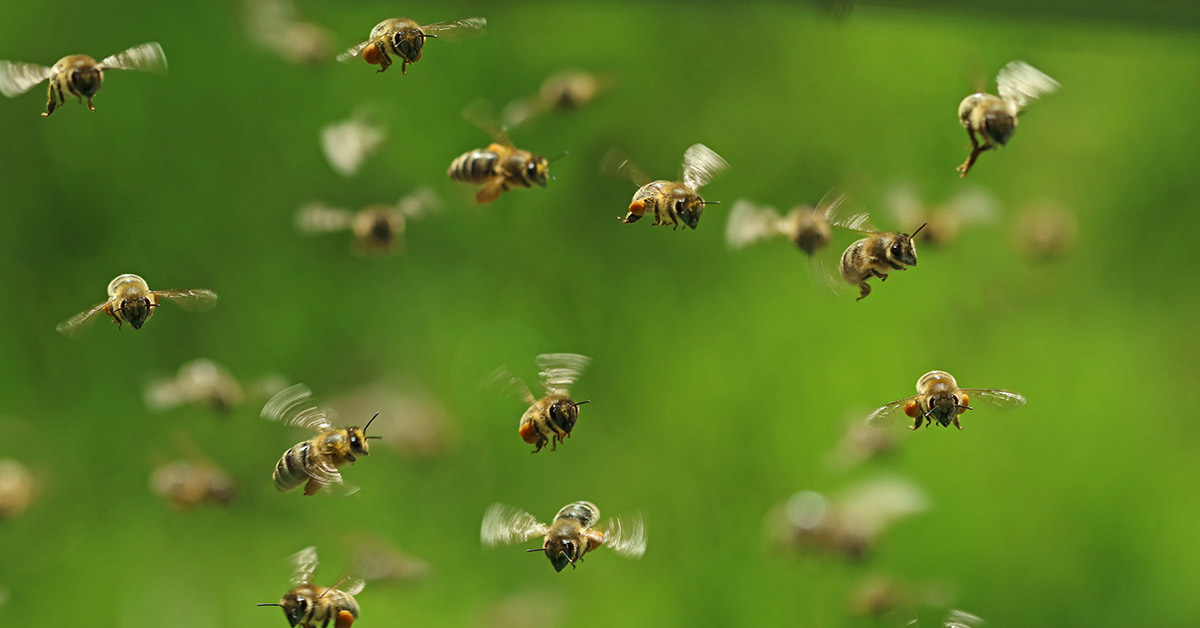

You walk outside one morning and there’s a seething, basketball-sized mass of bees hanging from your apple tree. Thousands of them. Moving, humming, clustered together like something out of a nature documentary. Your instinct says: run.
Here’s the thing — that instinct is almost certainly wrong.
Swarming bees are one of the most misunderstood events in the garden, and the fear they trigger is wildly disproportionate to the actual danger they pose. If you grow flowers that attract bees and pollinators, you may well encounter a swarm at some point. Knowing what’s actually happening — and what to do — makes the whole experience much less alarming.
Are Swarming Bees Dangerous?
The short answer: not really. According to Iowa State University Extension, honey bee swarms are not highly dangerous under most circumstances, and swarming bees feed heavily before leaving their hive, which actually reduces their ability to sting. They’re also away from the hive they’d normally defend — their eggs, their honey, their brood — which means they have almost nothing to protect and therefore almost no reason to sting you.
Purdue Extension puts it plainly: large swarms of honey bees are completely harmless unless provoked. Mississippi State University Extension is even more direct — swarms are not dangerous.
That said, they can absolutely sting if you disturb them. Don’t poke the swarm, don’t spray them with water, don’t try to knock them out of the tree. Leave them alone and the risk to you is extremely low.
What Is a Swarm, Actually?
A swarm isn’t bees going haywire. It’s reproduction. When a honeybee colony gets overcrowded, the old queen leaves with about half the worker bees to find a new home — and that mass of bees in transit is what you’re seeing on your tree branch or fence post. The workers cluster tightly around the queen to protect her while scout bees fan out looking for a suitable cavity to move into.
The swarm will typically stay put for a few hours to a couple of days while that scouting happens. Then they’re gone. It’s temporary, it’s natural, and from the bees’ perspective, they’re just in limbo — focused entirely on finding new housing, not on you.
Why They’re So Calm
This is the part that genuinely surprises people. A swarm of ten thousand bees hanging in your garden feels menacing. But bees are defensive, not aggressive — and defensiveness is specifically about protecting the hive. Without a hive, there’s nothing to defend. The bees are full of honey they ate before leaving, they have their queen with them, and they’re in a kind of collective holding pattern. They’re busy. They’re not thinking about you.
Compare that to disturbing an established colony in the ground or in your wall — that is when bees will defend themselves aggressively, because you’re threatening everything they’ve built. A swarm is the opposite situation.
What To Do If You Find a Swarm
Mostly: nothing. Give it space, keep children and pets away, and watch from a safe distance if you’re curious. Most swarms move on within 24 to 48 hours. If you genuinely can’t wait it out — say the swarm has landed somewhere that creates a real problem — contact a local beekeeper rather than a pest control company. Beekeepers actively want swarms. They’ll often come collect them for free and give those bees a proper home.
Spraying a swarm with insecticide is the one thing you should avoid. It’s dangerous (you’ll have thousands of agitated dying bees), it kills a colony of pollinators that your garden probably depends on, and it’s unnecessary given that the swarm would have left on its own. The same pollinators that visit your garden are worth protecting when they show up at your door, even in a more dramatic form.
When Should You Actually Be Concerned?
There are a few situations where a little more caution is warranted.
If you have a bee allergy. This is the real risk with any bee encounter. If you or someone nearby is allergic, give the swarm significantly more distance and have an epinephrine auto-injector available. This isn’t a swarming-specific concern — any bee sting can trigger anaphylaxis in sensitive individuals.
If the swarm moves into your walls or structure. Once bees find a cavity and start building comb, the situation changes. They’re no longer a temporary swarm — they’re an established colony with a nest to defend, and removal becomes substantially harder and more expensive. If you see bees actively entering and exiting a gap in your home’s siding, soffit, or chimney, call a beekeeper or pest control professional promptly. Don’t seal the entrance while bees are inside.
In areas where Africanized honey bees are present. In parts of the American Southwest, Texas, Florida, and other southern states, Africanized honey bees (sometimes called “killer bees”) can be present. These bees are the same species as European honeybees but defend their colonies far more aggressively — UF/IFAS Extension notes that Africanized bees can send out hundreds of bees to defend an area up to 40 yards from the colony. If you’re in an area where Africanized bees are established, it’s worth being more cautious with any unfamiliar swarm.
The Bigger Picture
Seeing a swarm in your garden is actually a good sign — it means there’s a healthy bee colony nearby that has grown large enough to reproduce. That’s the kind of ecological health that makes pollinators thrive and keeps your garden productive. The flowers, vegetables, and fruit trees that benefit from bee pollination are supported by exactly this kind of local bee population.
A lot of gardeners work hard to attract bees with flowering herbs and bee-friendly annuals — and then panic when a few thousand of those same bees show up for a visit. The swarm on your fence is not a threat. It’s evidence that your garden is doing something right.
Give it space, let it move on, and maybe take a photo. It’s genuinely something to see.
FAQ
Are swarming bees dangerous to humans? Generally no. Swarming bees have no hive to protect, have fed heavily before leaving, and are focused on finding a new home rather than defending anything. They’re significantly less likely to sting than bees near an established colony. The exception is if someone has a bee allergy, or in areas where Africanized bees are present.
How long will a bee swarm stay in one place? Usually a few hours to a couple of days. Scout bees are searching for a permanent location during this time. Once they find it, the swarm takes flight and moves on. If you leave them alone, they’ll almost always resolve themselves.
Should I call an exterminator for a bee swarm? Before calling an exterminator, contact a local beekeeper. Beekeepers actively want swarms and will often collect them for free. Killing a healthy swarm is both unnecessary and ecologically counterproductive.
What if bees swarm near my children or pets? Keep everyone calm and move them away from the swarm without running or swatting. Sudden movements and vibrations can provoke defensive behavior. Give the swarm a wide berth — 20 to 30 feet — and the risk is very low.
Can I speed up a swarm leaving my yard? Not really, and trying usually makes things worse. The most effective approach is to leave the swarm completely undisturbed. Noise, vibrations, water, or spraying will agitate the bees and could provoke stings without actually making them leave faster.
What’s the difference between a swarm and an established colony? A swarm is bees in transit — temporary, docile, and unlikely to sting. An established colony has a nest with comb, brood, and honey to protect, and will defend it. If you see bees regularly entering and exiting a fixed location (like a wall, tree hollow, or eave), that’s a colony, not a swarm, and it needs professional attention.