

What Heliotropism Actually Means

Heliotropism, or solar tracking, is when a plant follows the movement of the sun during the day. Rooted in ancient Greek, “helio” refers to the sun and “tropism” means a turning or movement of a living organism toward or away from an external stimulus, such as light, heat, or gravity.
The sunflower, known scientifically as Helianthus annuus, is the best example of a plant that displays this phenomenon. Young sunflower plants follow the sun from east to west during the day and then reorient themselves during the night to face east in anticipation of the sunrise.
This property of facing the sun is mostly observed in young flower heads and generally stops once the flower starts to bloom. The fascinating phenomenon of flowers following the sun across the sky is what scientists formally call heliotropism.
The Daily Rhythm of a Young Sunflower

A young flower faces east at dawn and greets the sun, then slowly turns west as the sun moves across the sky. During the night, it slowly turns back east to begin the cycle again.
Sunflowers swing their heads by growing a little more on the east side of the stem, pushing the head west, during the day and a little more on the west side at night, so the head swings back toward the east. It’s a continuous, self-correcting oscillation that runs without pause throughout the growing season.
This nocturnal “reset” is driven by asymmetrical stem growth, where the side of the stalk facing west elongates faster than the eastern side under the cover of darkness. By moving during the night, the plant ensures it is perfectly oriented to capture maximum solar radiation the moment the sun rises.
The Internal Clock Driving It All

In a study published in the journal Science, researchers found that the young plant’s sun-tracking can be explained by circadian rhythms, the behavioral changes tied to an internal clock that humans also have, which follow a roughly 24-hour cycle.
Their heliotropic motion is a circadian rhythm, synchronized by the sun, which continues if the sun disappears on cloudy days or if plants are moved to constant light. That detail is telling. The plant isn’t just passively reacting to sunlight in real time. It’s running on a biological schedule.
In support of the circadian rhythm theory, plants exposed to artificial light at different intervals “could reliably track the movement and return at night when the artificial day was close to a 24-hour cycle, but not when it was closer to 30 hours.” Mess with the clock, and the tracking falls apart.
How the Stem Actually Bends

Researchers found that the plant’s turning is actually a result of different sides of the stem elongating at different times of day. It’s not that the plant is twisting or pivoting. It’s growing its way across the sky, one side at a time.
Sunflowers follow the sun through differential growth on opposite sides of the stem, regulated by auxin distribution and light sensitivity. Auxin is a plant hormone that promotes cell elongation, and its uneven distribution is what makes the bending possible.
Most plants show phototropism, the ability to grow toward a light source. Plant scientists had assumed that sunflowers’ heliotropism would be based on the same basic mechanism, which is governed by a molecule called phototropin and responds to light at the blue end of the spectrum. What researchers found instead surprised them considerably.
A Surprising Discovery About How Sunflowers “See” the Sun

New work from plant biologists at the University of California, Davis, published in PLOS Biology, shows that sunflowers use a different, novel mechanism from that previously thought. “This was a total surprise for us,” said Stacey Harmer, professor of plant biology at UC Davis and senior author on the paper.
Indoors, sunflowers grew straight toward the light, activating genes associated with phototropin. But the plants grown outdoors, swinging their heads with the sun, showed a completely different pattern of gene expression. There was no apparent difference in phototropin between one side of the stem and another.
Blocking blue, ultraviolet, red, or far-red light with shade boxes had no effect on the heliotropism response. This shows that there are likely multiple pathways, responding to different wavelengths of light, to achieve the same goal. The exact genes involved in outdoor heliotropism have not yet been fully identified.
Why the Movement Slows Down and Stops
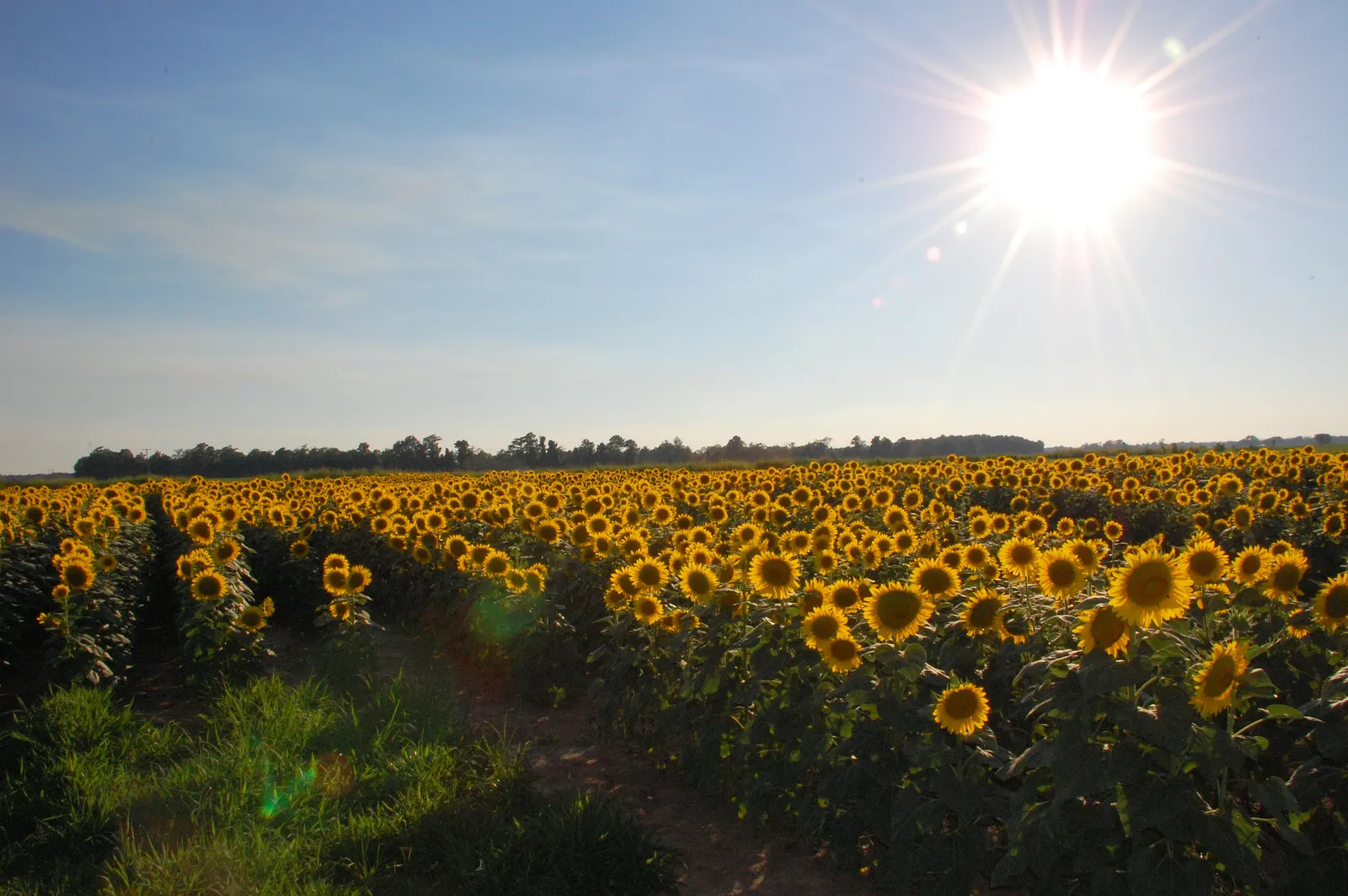
When growth of the flower stalk stops and the flower is mature, the heliotropism also stops and the flower faces east from that moment onward. The mechanism behind this is straightforward once you understand how the tracking works in the first place.
As overall growth slows down, the circadian clock ensures that the plant reacts more strongly to light early in the morning than in the afternoon or evening, so it gradually stops moving westward during the day.
As the plant matures, the stem turns stiff and woody and the daily tracking fades out, leaving the bloom locked toward the east. The biology that once enabled flexible movement becomes rigid. There’s simply no longer any differential growth left to do the bending.
The Cost of Not Being Able to Track

The researchers tied plants up so they couldn’t move or turned them away from the sun, and they found those flowers eventually had “decreased biomass and less leaf area” than flowers that could move with the sun. This was a clear demonstration that the movement isn’t decorative.
Heliotropism optimizes light interception of young sunflower plants, increasing it by ten percent or more. Increased light capture improves plant performance with more leaf area and increased biomass.
The tracking phase, in other words, is genuinely productive. It’s what helps a young sunflower accumulate the resources it needs to reach maturity. Once it has done that job, locking into position serves a completely different but equally important purpose.
Why East Is the Right Direction to Settle Into

Sunflowers face the rising sun because increased morning warmth attracts more bees and also helps the plants reproduce more efficiently, according to a study by researchers at the University of California, Davis.
In a series of experiments, researchers found that the east-facing heads were significantly warmer in the morning than west-facing flower heads. That warmth brings an energy benefit to foraging bees early in the morning.
Remarkably, flower heads that faced east received five times more pollinators in the morning than heads that faced west. That is not a small difference. It represents a major reproductive advantage locked in by orientation alone.
Seed Quality and Reproductive Success

The orientation of the plants also affected flower development and reproductive success. East-facing plants tended to produce larger and heavier seeds. They also released pollen earlier in the morning, coinciding with the times when bees visit.
The east-facing sunflowers started releasing their pollen earlier in the morning, by about 30 minutes, timing which pretty neatly matched the time delay between peak pollinator visit times.
The team found that pollen from the east-facing plants was responsible for more offspring than that from west-facing plants. That finding, confirmed through genotyping, makes it plain that fixed eastward orientation is not an accident of anatomy. It’s a strategy.
A Landmark First for Plant Biology Research

The research represents “the first example of a plant’s clock modulating growth in a natural environment, and having real repercussions for the plant,” according to UC Davis professor and study co-author Stacey Harmer.
UC Berkeley professor and study co-author Benjamin Blackman noted that the connection between circadian rhythms and growth could be applicable to other research beyond sunflowers. The implications reach into agriculture, plant genetics, and even the design of solar energy systems.
Published research from 2025 investigated the feasibility of a sunflower-based heliotropic mechanism for tracking solar photovoltaic panels, aiming to optimize the efficiency of solar energy systems. Inspired by the natural heliotropism observed in sunflowers, the study explored the design and implementation of a nature-inspired solar panel tracking system. The sunflower’s biology, it turns out, has engineering value too.
The Bigger Picture

There’s something quietly elegant about what sunflowers do. They spend their youth in constant motion, chasing light, building mass, and storing energy. Then, at exactly the right moment, they stop. Not because something has gone wrong, but because the most useful thing they can do next is hold still and face the warmth.
A common misconception is that sunflowers follow the sun across the sky all season long, but biological tracking known as heliotropism ends once the flower matures. Young, developing buds follow the sun from dawn to dusk, driven by an internal circadian clock, but as stems turn woody and blossoms fully open, that movement stops completely.
The shift from motion to stillness isn’t a loss. It’s a transition from one strategy to another, each perfectly suited to the stage of life the plant is in. That’s the kind of efficiency that takes millions of years of evolution to work out, and the sunflower has it down to a remarkably fine point.
AI Disclaimer: This article was created with the assistance of AI tools and reviewed by a human editor.