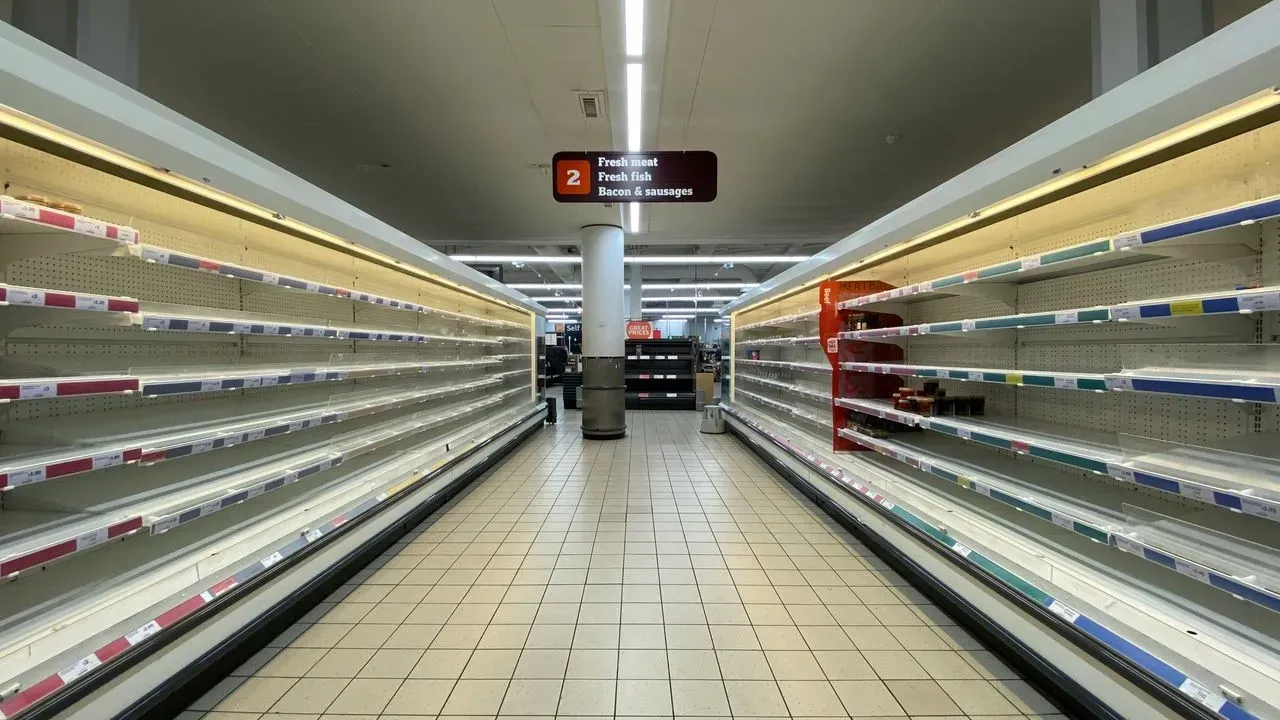

Shoppers often walk past full displays at the front of a supermarket and still leave without the one item they came for. That gap between what stores stock and what customers find is drawing attention as grocers pour more money into software, automation and data tools. The industry’s spending is large, but the stock problems have not disappeared, as ([1])reports.
A technology budget that keeps growing
U.S. food retailers spent more than $20 billion on technology in 2025, according to FMI, the Food Industry Association. That amount equals nearly 2 percent of sales and roughly doubles the share spent in 2024. Grocers are not easing off, either. Some 71 percent of surveyed retailers expected technology spending to rise again in 2026.
The list of investments is long. Retailers are building out artificial intelligence, electronic shelf labels, retail media networks, loyalty platforms and forecasting systems. The technology is changing quickly, and the scale of spending shows how seriously the industry takes it.
Empty shelves still show up in the numbers
Even with that outlay, out-of-stock rates remain high. The National Grocers Association’s 2026 financial study found that independent supermarkets recorded a 6.6 percent out-of-stock rate in fiscal 2025. FMI’s research on the wider industry put the figure at 5.8 percent. Each percentage point represents products customers came to buy and could not find.
The same study shows the pressure independent grocers face. Their results for fiscal 2025 included:
- Same-store sales growth of just 0.4 percent
- Inventory turns falling from 17.8 to 16.1
- Shrink, meaning lost product, rising to 3.9 percent of sales
Those figures leave little room for error in a business that already runs on thin margins.
When the records say the product is there
One of the most striking findings in a new RETHINK Retail report concerns inventory accuracy. The report cites a study in the Journal of Business Logistics that examined roughly 24,000 stockkeeping units across 11 grocery stores. In that setting, inventory audits produced an 11 percent storewide sales increase, with the biggest gains among products whose computer records overstated what was actually on hand. The author of the original article stresses that such results are not typical, though the underlying problem is familiar to anyone who has managed a stockroom.
The mechanism is easy to picture. A system may show 12 units of an item when only three remain. If the missing nine were damaged, stolen or thrown away without being logged, the replenishment system has no reason to place a new order. The shelf stays empty while the records say otherwise.
Better forecasting does not solve that on its own. Artificial intelligence can weigh purchasing patterns, weather, promotions and many other variables, yet its recommendations depend on reliable data. The old computing principle of garbage in, garbage out still applies, and an advanced forecasting system can be undermined by inaccurate counts just as easily as a basic one.
One store, several jobs, one workforce
Today’s supermarket serves as a shopping destination, an online fulfillment center, a delivery hub, a pickup location and an advertising platform. These roles draw on the same inventory and the same employees. Staff must restock shelves, maintain displays, manage fresh departments, fill digital orders and respond to alerts.
A 2026 Verizon study found that 52 percent of surveyed grocery retailers identified inventory visibility and accuracy as a major operational challenge. Hiring and retaining employees ranked higher, at 67 percent. Technology meant to coordinate those tasks can add to the workload when systems fail to connect with one another.
Better execution as the next test
The RETHINK Retail report, published November 11 in partnership with technology provider OrderGrid, argues that grocers may find their biggest gains in the stores they already operate. It makes the case for improving existing locations before committing more capital to expansion. FMI reports that more than half of surveyed food retailers and suppliers already see returns from their technology investments. The harder question is whether those returns show up in operational results rather than in the sophistication of the systems installed.
The arithmetic is simple. A supermarket generating $30 million in annual sales that recovered just 1 percent in revenue through better availability and execution would add $300,000 a year. Across a 50-store regional chain, the total would approach $15 million. These are illustrative figures rather than forecasts for any particular chain, but they explain why operators with rising labor and occupancy costs are paying attention.
The original author expects the industry to spend more in 2027 than in 2026 on artificial intelligence, digital commerce and new locations. For shoppers, the measure of that spending will be far simpler than any dashboard: whether the item they came for is on the shelf when they arrive.
AI Disclaimer: This article was created with the assistance of AI tools and reviewed by a human editor.