

Most people don’t think twice about what’s happening in their garage. It’s a threshold space, somewhere between the house and the outside world, and it tends to absorb whatever doesn’t fit anywhere else. Over time, though, what piles up there can quietly say more about your mental state than you might expect.
The connection between physical spaces and psychological well-being is well established in research, and the garage turns out to be one of the more revealing rooms in the home. Not because it’s the fanciest, but precisely because it’s the one we tend to ignore the most.
The Garage Has Become America’s Most Cluttered Room

More than three in five American adults, around 62 percent of those surveyed, feel their garage is the most cluttered space in their home. On top of that, 36 percent of Americans say their garage is so disorganized they can no longer park a vehicle inside. That’s a staggering number of households where the garage has essentially stopped functioning as a garage.
A UCLA study of 32 Los Angeles-area families found that 75 percent of them did not use their garages for parking at all. Researchers also found that disorganization, not a lack of space, causes roughly 80 percent of household clutter. In other words, more room wouldn’t necessarily help. The underlying habits are the actual issue.
Clutter Raises Your Cortisol, the Stress Hormone

Studies have shown that clutter increases cortisol levels, the primary stress hormone in the body. Physical clutter not only fills our spaces but also our minds, leading to mental fatigue, stress, irritability, and heightened anxiety.
UCLA research found that clutter raises cortisol by approximately 25 percent in people who live with it, a figure that reflects findings from Princeton, UCLA, and other institutions linking clutter to elevated stress hormones, reduced focus, and poorer sleep. A garage you can barely walk through is not a neutral space. It is a slow, persistent source of physiological stress every time you open the door.
A Chaotic Garage Signals Your Brain That Work Is Never Done
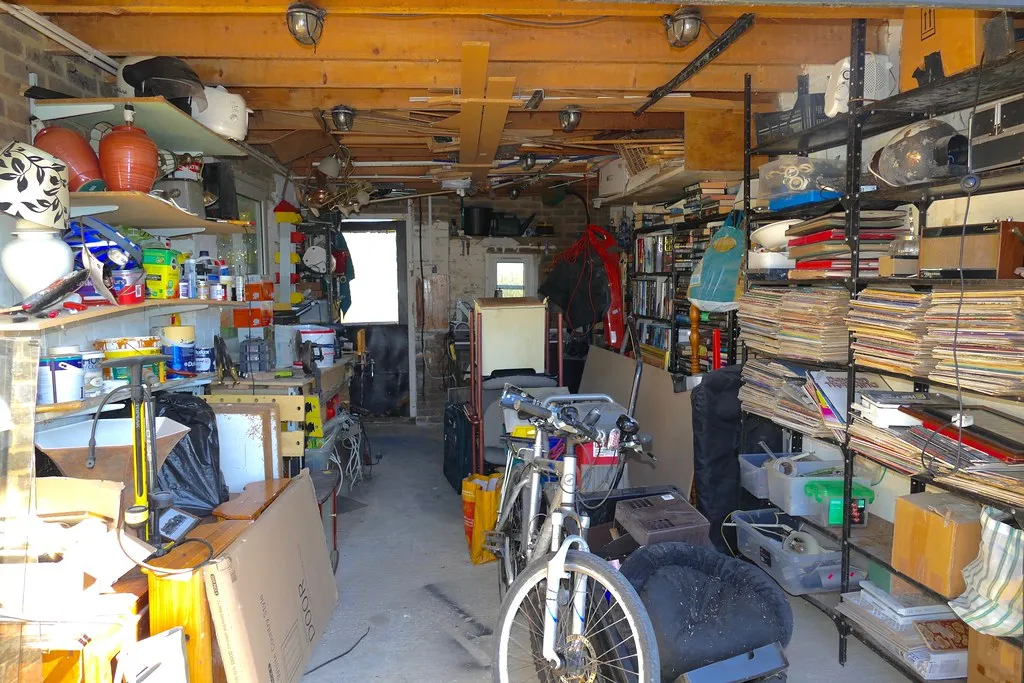
Research shows that clutter creates visual chaos that overwhelms the brain’s processing capacity. When surrounded by disorganized items, our cortisol levels can increase and our ability to focus diminishes. The brain interprets clutter as unfinished business, creating a persistent low-level stress response.
The mind subconsciously interprets clutter as unfinished work. Every object lying around becomes a mental reminder of what’s pending. Applied to the garage, this means that every time you walk past a heap of boxes or tangled tools, your brain registers a small but real cognitive demand. Multiply that across days and weeks, and the toll adds up.
It Affects Your Mood Throughout the Day

A 2025 study published in the Journal of Environmental Psychology found that people who considered their homes more cluttered had lower levels of well-being and life satisfaction, as well as higher levels of negative feelings.
Women appear to be disproportionately affected: those who described their home environments as stressful showed detrimental daily patterns of cortisol. For wives specifically, a higher stressful home score was associated with a more depressed mood as the day progressed, while husbands’ moods remained largely unaffected. The garage is part of that home environment, and its condition shapes emotional tone from the moment you leave for work in the morning.
Your Garage Clutter Can Disrupt Your Sleep

New research shows clutter may do far more than make a home look messy. It can quietly affect sleep, relationships, focus, eating habits, and even broader mental health.
A cluttered garage can induce stress that manifests physically through headaches, fatigue, and sleep disturbances. Even if your garage isn’t where you sleep, chronic low-grade stress from disorganized spaces carries into the bedroom. Conversely, an organized space promotes relaxation, positively influencing overall well-being. The sequence is simple: less visible disorder generally means a quieter nervous system at night.
The Social Cost: Avoiding Guests and Hiding Spaces

In one recent survey, 74 percent of respondents reported experiencing stress or anxiety when confronted with cluttered areas, while 32 percent said they avoid inviting guests into their homes because of concerns about clutter. Another 26 percent said clutter had negatively affected their relationships.
One survey found that one out of five homeowners has actually gotten into an argument with a spouse about the organizational state of their garage. That’s a surprisingly direct line between a pile of old sports equipment and relationship conflict. The garage, of all rooms, becomes a flashpoint because it often represents competing priorities and avoidance habits made visible.
Clutter Feeds Procrastination, and Procrastination Feeds More Clutter

Clutter, meaning an overabundance of possessions, may impede one’s quality of life by interfering with space livability and social connections and prompting negative affect and financial problems.
Research using latent class analysis found that persons who struggle with clutter reflect distinct groups based on their cognitive processes, with hesitant and indecisive participants experiencing greater negative impacts of clutter than action-oriented and decisive participants. Clutter can inhibit action, leading to procrastination and further disorganization. It’s a self-reinforcing loop that the garage is especially good at hiding from view, until it isn’t anymore.
The Princeton Finding: Clutter and Cognitive Overload

Researchers at the Princeton University Neuroscience Institute, publishing in the Journal of Neuroscience, found that when an environment is cluttered, the chaos restricts one’s ability to focus. Clutter limits the brain’s ability to process information, distracts, and makes processing information much more difficult than it would be in an uncluttered, organized environment.
A cluttered environment can lead to cognitive overload, as the brain struggles to prioritize attention amid constant distractions. Consider what happens when you need a tool quickly in a chaotic garage. You dig, you search, you grow frustrated. That micro-stressor, repeated dozens of times a month, is not trivial. It’s a measurable drain on cognitive energy and mood.
The Organized Garage as a Mental Health Signal

More than three quarters of homeowners in the United States have planned to declutter and organize their garages, according to survey findings from Craftsman. The intention is clearly there. The follow-through is often where people stumble.
A large majority of homeowners, roughly 76 percent, say the garage can be the most productive part of the house. In fact, 28 percent surveyed said the garage has played a role in the development or growth of a side hustle. A well-organized garage, then, isn’t just tidy. It is actively usable, which has its own psychological payoff. Maintaining an organized garage contributes to a healthier mindset over time.
What the Clutter You Keep Actually Reveals

We will all live with clutter and disorganization to some degree in our lives. Sometimes, however, significant clutter problems can be linked to underlying mental health conditions such as obsessive-compulsive disorder, hoarding disorder, major depressive disorder, attention deficit hyperactivity disorder, and anxiety disorders.
Sometimes clutter signals an underlying condition that needs attention. Other times, how clutter impacts mental health becomes a contributing factor that makes existing symptoms worse. The garage is rarely the cause of someone’s anxiety, but it often reflects it with uncomfortable accuracy. When the rest of the home is managed but the garage is in chaos, that tells its own story about which stresses we’re avoiding and which we’ve quietly accepted as permanent.
The Takeaway

The garage doesn’t have to be pristine to be healthy. Most people’s garages will always carry some level of functional mess. The line worth paying attention to is when the space stops being usable, when it starts generating friction rather than serving a purpose.
What the research consistently points to is a simple relationship: the more visual disorder we accept as permanent backdrop, the higher our baseline stress tends to run. Disorganized environments constantly compete for our attention, over-stimulating the brain and creating a low-grade but persistent sense of stress. That low-grade quality is exactly what makes it easy to dismiss, right up until it isn’t so easy anymore.
The garage, it turns out, is worth looking at honestly. Not because a tidy one guarantees peace of mind, but because a chronically neglected one rarely exists entirely on its own.
AI Disclaimer: This article was created with the assistance of AI tools and reviewed by a human editor.