
Walk through almost any garden bed, wooded trail, or patch of moist mulch and you might notice something strange sitting on the ground. Tiny cup-shaped structures, no bigger than a fingernail, filled with what look like perfectly arranged miniature eggs. Most people walk right past them. Those who stop to look tend to do a double-take.
These are the bird’s nest fungi, and they’re one of the more quietly remarkable things living in the leaf litter beneath our feet.
What Exactly Are Bird’s Nest Fungi?
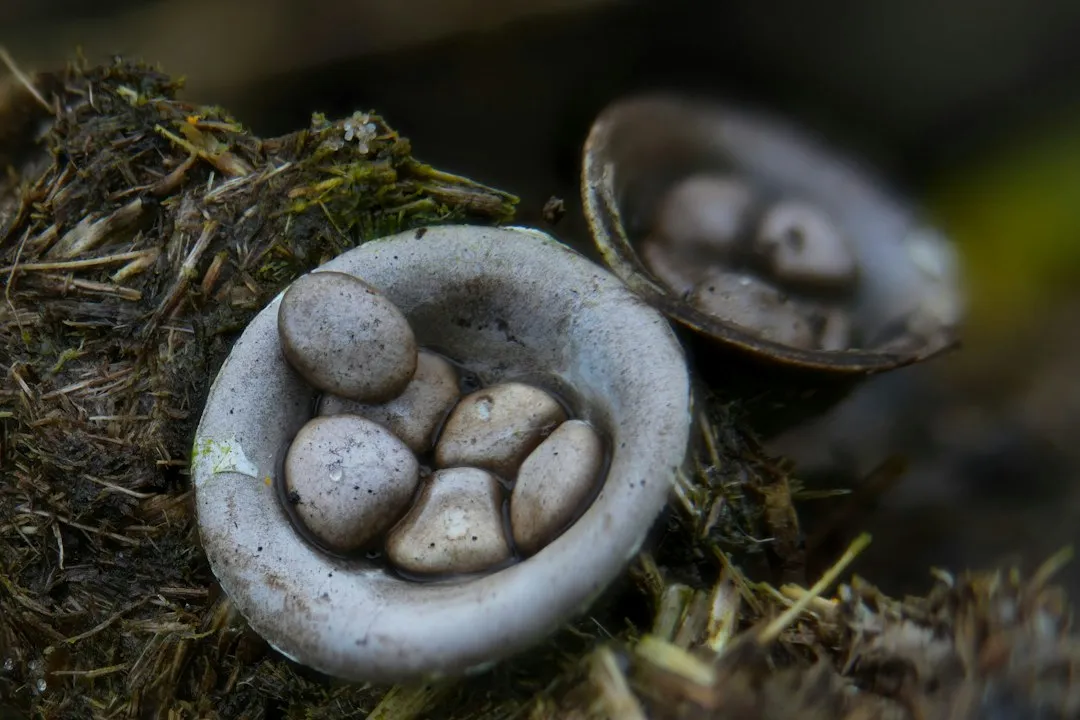
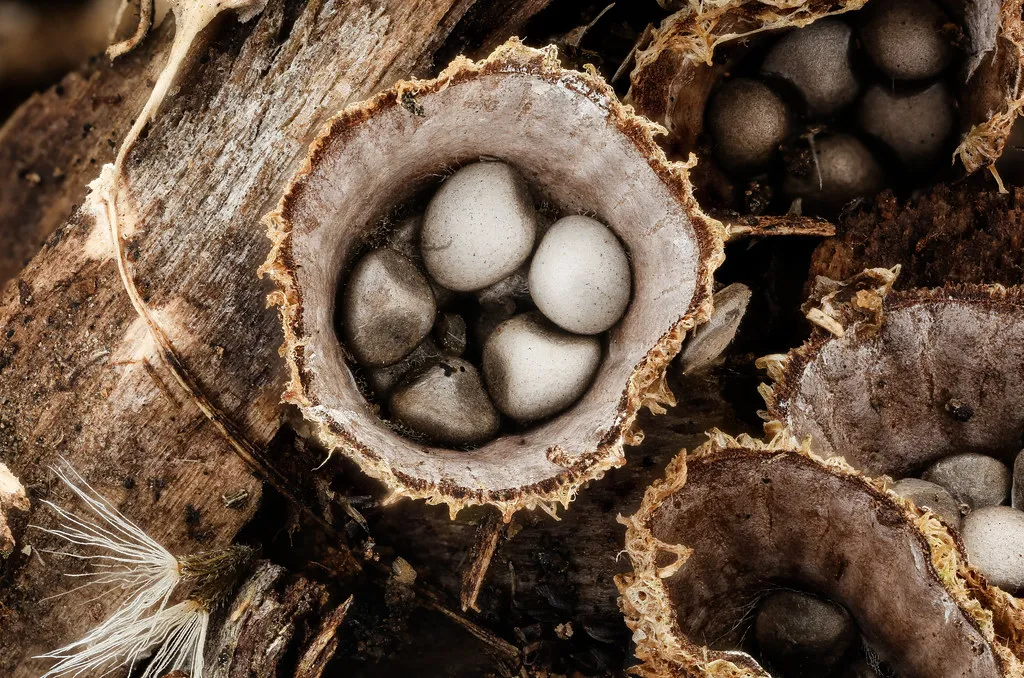
Bird’s nest fungi are members of the fungal division Basidiomycota and belong to the family Nidulariaceae, a name derived from the Latin word “nidulus” meaning “small nest.” They received their common name because of the cup-shaped fruiting body that resembles a tiny bird’s nest filled with small eggs. More precisely, they are charismatic mushrooms that contain multiple tiny egg-like structures inside each cup.
The family Nidulariaceae, within the order Agaricales, contains about 60 species. Strangely, the bird’s nest family sits in the same order as gilled mushrooms. Despite looking nothing like a typical mushroom, these organisms are classified right alongside the familiar cap-and-stem fungi most people picture when they hear the word.
The Five Genera: A Closer Look at the Family
Bird’s nest fungi are cosmopolitan and there are five genera: Crucibulum, Cyathus, Mycocalia, Nidula, and Nidularia. Of these, Cyathus and Crucibulum are cosmopolitan in their distribution, while the others have more limited ranges.
Among these genera, Cyathus is the largest, with 61 species documented so far in the world. The name Cyathus is Greek for “cup,” whereas Crucibulum is a Latin word for “melting pot,” both referring to the general shape of these fungi. Each genus has its own distinct personality, and telling them apart comes down to subtle but reliable visual cues.
How to Tell the “Eggs” Apart by Color
One key to identification lies in the color of the eggs. Cyathus species have black eggs, while Crucibulum species have black eggs surrounded by a white membrane, making them appear white. Mycocalia has yellowish or reddish-brown eggs, while Nidula and Nidularia species have brown eggs.
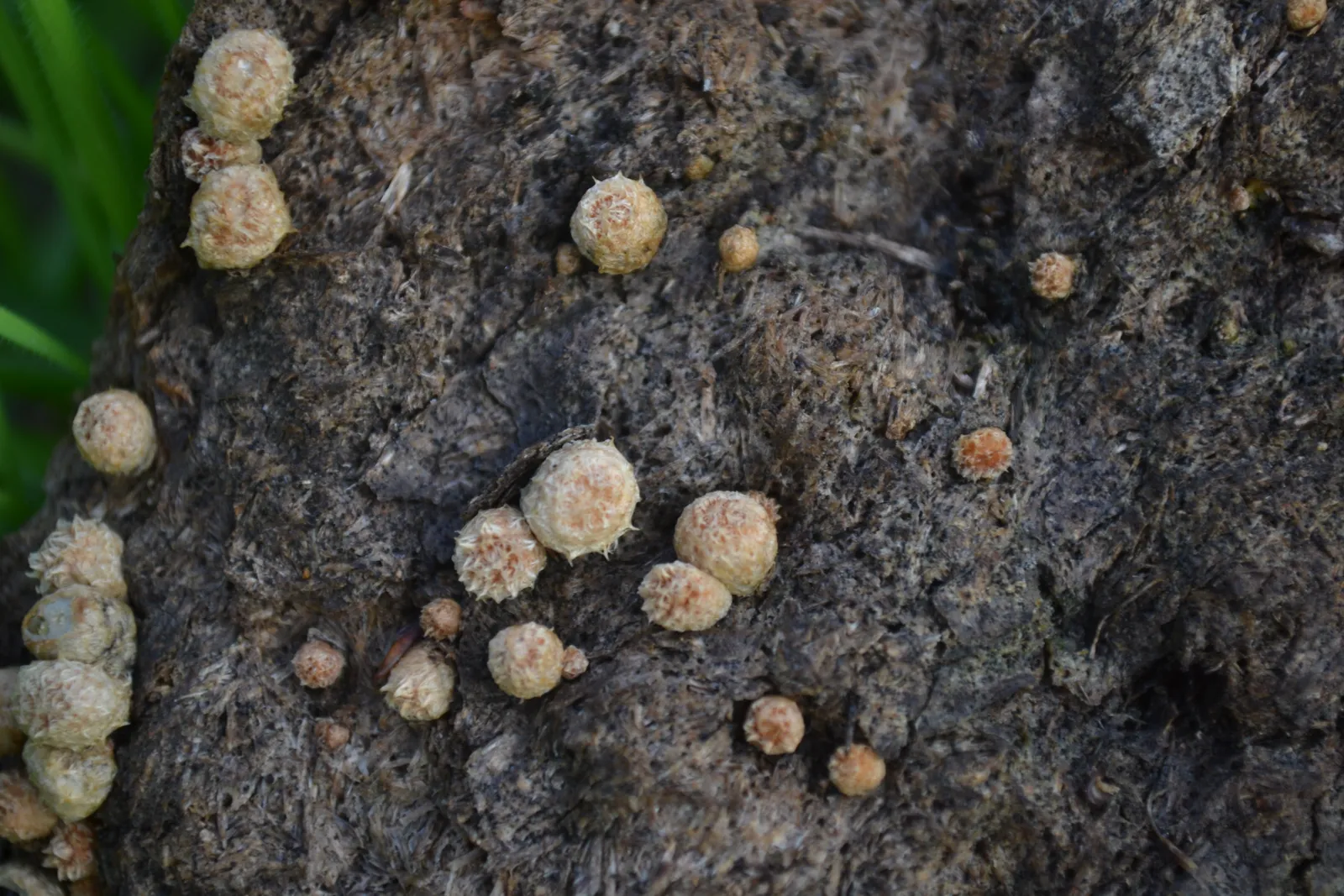
In the immature stage, the peridia of some species are topped with a fuzzy covering, typically white for Cyathus species and yellow for Crucibulum species. As the fungus matures, this covering opens and exposes the peridioles to the outside world. It’s a gradual reveal, almost theatrical in its timing.
The Remarkable Size and Structure of the Fruiting Body
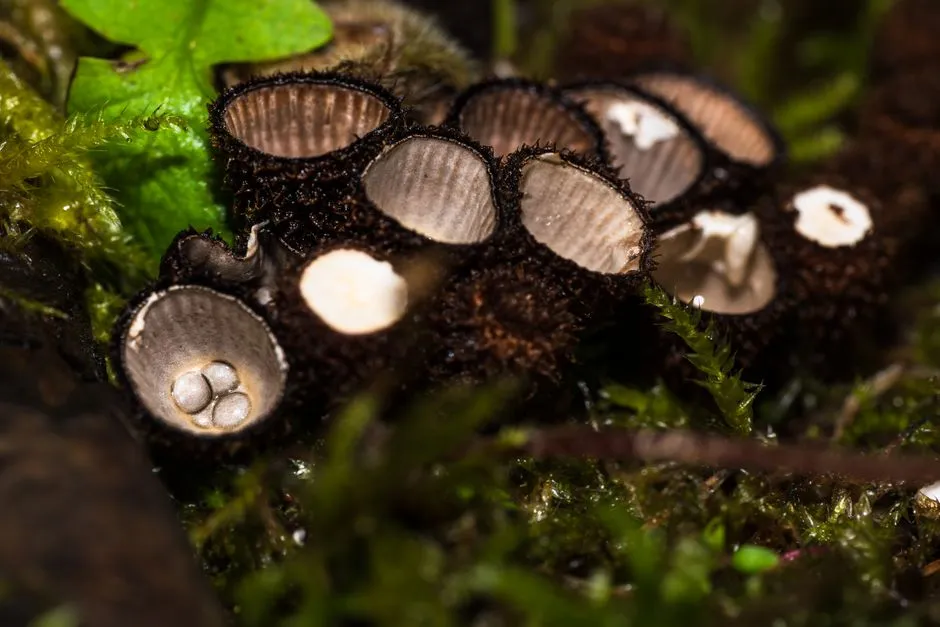
Bird’s nest fungi are typically 3 to 10 mm tall, and the peridioles are usually 1 to 3 mm in diameter. They are also highly diverse in their shapes and sizes, ranging from 1 to 25 mm in height and 2 to 10 mm in width. For something so small, they pack in an extraordinary amount of structural complexity.
They appear in a variety of shapes such as cylindrical (cup-shaped), conical (inverted cone-shaped), and globose (ball-shaped). The nest is called the peridium and the eggs are known as peridioles. The nest attaches itself to a substrate via fungal strands known as mycelium.
The Ingenious Splash-Cup Spore Dispersal Mechanism

The shallow cup-like top of the fungus uses the energy of raindrops to splash the peridioles into the surrounding environment. This “splash-cup” mechanism has been observed in several other species of fungi and flora as a means of dispersal.
High-speed video analysis reveals that peridioles are most effectively ejected when raindrops strike the rim of the saucer-shaped fruiting body. When a raindrop hits the rim, it courses down into the cup and splashes back up. The firm sides of the cup, angled at around 60 to 70 degrees, direct the splash upward and outward with surprising force, ejecting the peridioles up to six feet away.
Impressively, this process uses less than two percent of the kinetic energy of the raindrop, making it a highly efficient transfer mechanism. That level of energy efficiency is genuinely hard to improve upon, even with modern engineering in mind.
The Funiculus: Nature’s Tiny Lasso
In Cyathus and Crucibulum species, peridioles are splattered upward by rain and become entangled on nearby vegetation using funiculi, which are specialized thin cords that originally attach the peridioles to the peridium, and hapterons, which are the adhesive ends of the funiculus that stick to the surface of vegetation.
Each egg is attached to the cup by a tiny coiled cord called a funiculus. When the egg is ejected, this cord unravels and acts like a lasso with a sticky weight at the end, wrapping around grass stems or twigs and suspending the egg in the air to dry and disperse spores from a higher vantage point. In Nidularia, Nidula, and Mycocalia, no funiculi are present at all; instead, those peridioles are embedded in a gel.
A Staggering Number of Spores
As the fungus matures, the egg-like spore mass forms within the nest. There can be as many as 30 million spores in a single peridiole, so an individual bird’s nest fungus fruiting body could have more than a billion spores. That figure puts their reproductive ambition into a new perspective.
The peridioles degrade over time to eventually release the spores within, or they may be eaten by herbivorous animals and redeposited after passing through the digestive tract. What exactly happens next is not completely clear, but eventually the spores are dispersed from the egg, germinate, and create mycelia, which eventually produce more fruiting bodies.
Where They Grow and How to Find Them
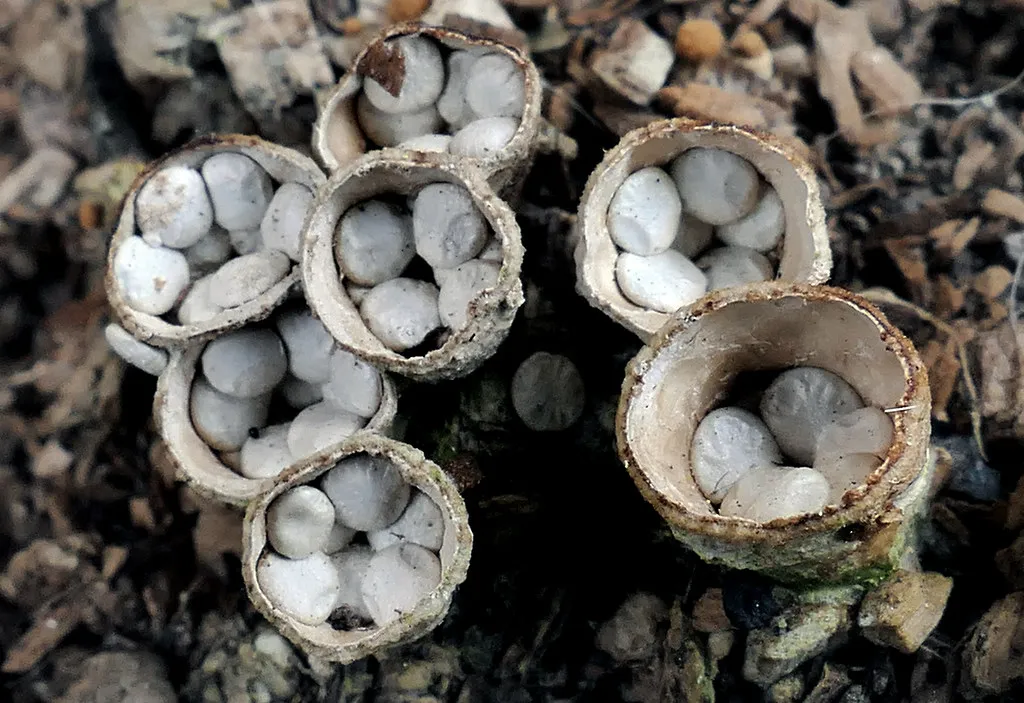
Because the ecological role of bird’s nest fungi is to decompose wood, they are extremely common in disturbed areas with plant debris and mulch, such as trails and backyard gardens. These fungi tend to grow in large clusters, so it is common to see ten to a hundred nests at once.
Bird’s nest fungi have an extremely wide distribution and are found on all continents except Antarctica. These fungi are often found in shaded, moist environments, and typically survive on plant debris, soil, decaying wood, or animal excrement from cows and horses. If you garden with wood chip mulch, there is a reasonable chance they have already visited your backyard without you noticing.
Resilience Under Extreme Conditions
The majority of Cyathus and Crucibulum specimens have been collected in open areas or disturbed habitats where fruiting bodies were directly exposed to sunlight and sometimes to intense heat and desiccation. This suggests these fungal species are well-adapted to grow and reproduce after exposure to intense UV radiation and high heat.
Researchers tested peridioles of three phylogenetically distant bird’s nest fungi species from three different genera: Cyathus poeppigii, Nidularia pulvinata, and Crucibulum parvulum. They exposed the peridioles to extremely high temperatures up to 80 degrees Celsius, extremely low temperatures down to minus 196 degrees Celsius, and prolonged UV-C radiation exposure for up to 168 hours. The study, published in 2025, reinforces just how durable these tiny structures can be.
Medicinal and Bioactive Potential
To date, there is no evidence to suggest that bird’s nest fungi are pathogenic to plants or toxic to humans or other animals. On the contrary, some species show significant neurotrophic and neuroprotective activities due to their production of cyathane diterpenoids.
Research has shown that Cyathus striatus produces unique chemical compounds called cyathins. These diterpenoids have demonstrated antibiotic properties and are being studied for their potential to stimulate the production of Nerve Growth Factor, which could be relevant for treating neurodegenerative diseases. Bird’s nest mushrooms are also able to produce secondary metabolites that exert antimicrobial, antitumor, and anti-neuroinflammation activities.
Ongoing Research and What Scientists Are Still Learning
Researchers have presented phylogenomic analyses of bird’s nest fungi and related Agaricales fungi to gain insight into the evolution of Nidulariaceae. A species tree was constructed using 17 newly generated genomes of bird’s nest fungi and representatives from all major clades. Specifically, 1,044 single-copy genes were used to explore the intergeneric relationships and pinpoint the placement of Nidulariaceae within Agaricales.
Phylogenetic relationships among all extant genera are still being resolved, and Nidula and Nidularia in particular require further taxonomic study. As recently as August 2024, researchers in South Australia collected a rare specimen of Mycocalia denudata growing on kangaroo dung, highlighting how much discovery remains possible even in well-surveyed regions. For a family of fungi this small, the science is far from settled.
The Takeaway
Bird’s nest fungi are easy to overlook, but they reward the curious. They are not considered dangerous to plants, animals, or humans. Instead, they quietly dismantle dead wood, recycle nutrients back into the soil, and fire off spore packages using nothing more than falling rain. Their scale is miniature, but the engineering is exceptional.
There’s something worth sitting with here. One of the most elegantly designed dispersal systems in the natural world operates silently in garden mulch, measuring less than a centimeter across, noticed by almost nobody. The bird’s nest fungus doesn’t ask for attention. It just keeps working.
AI Disclaimer: This article was created with the assistance of AI tools and reviewed by a human editor.