

There’s something quietly melancholy about sitting in someone’s grandmother’s home and discovering a worn, leather-bound book on the side table, filled with decades of handwritten names, hometowns, and little notes from people who passed through. You flip the pages, and the house suddenly has a history. That book was a guest book, and most of us haven’t thought about one in years.
The guest book was once a genuine fixture of domestic life. Today, it’s practically gone from private homes, replaced by group chats, Instagram tags, and digital calendars. Whether that’s a loss worth mourning is an interesting question, and the evidence suggests it probably is.
Where the Tradition Actually Comes From
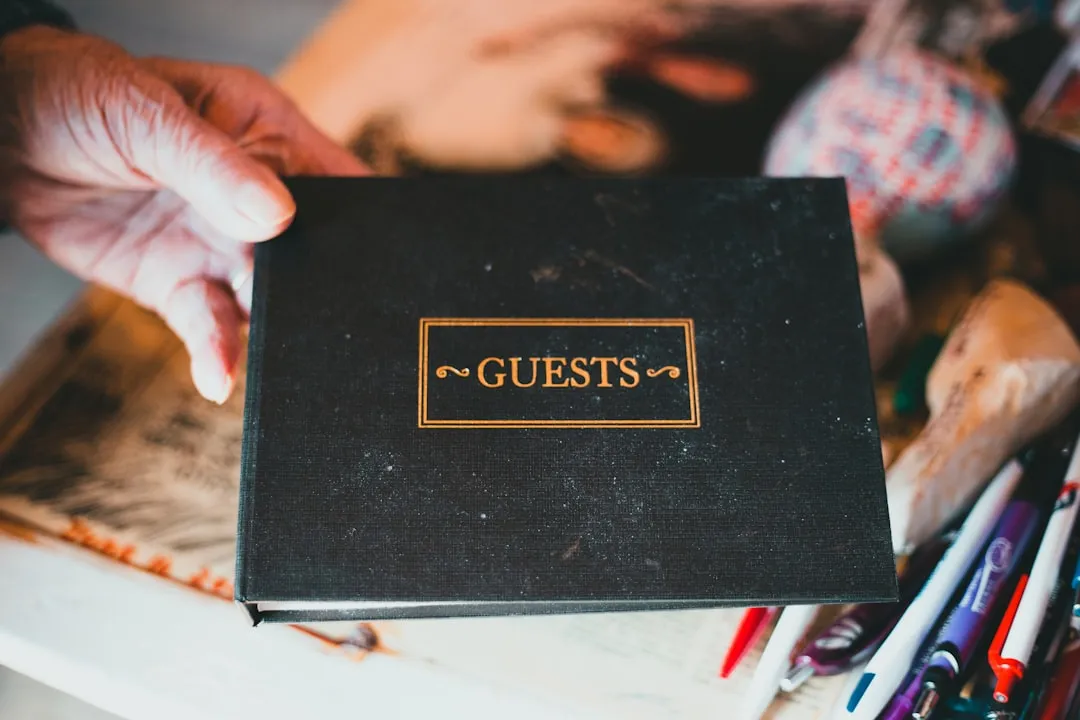
The guest book has a much longer history than most people assume. The tradition has storied antecedents in medieval monasteries, notably the Grand Chartreuse in Savoy. Over time, the practice moved from religious institutions into secular spaces, eventually becoming a fixture of private and social life.
By the 17th century in Europe, visitors’ books emerged more formally in castles, parish churches, noblemen’s homes, and aristocrats’ residences to log arrivals and social interactions. These weren’t merely registers for names. They were records of who mattered, who visited, and what a household stood for.
This practice, dating back to the 19th century in the United States, fostered a sense of community among travelers by ritually connecting them to previous visitors through shared inscriptions, often including addresses or hometowns to log demographics and build a historical record. The guest book was, in short, a living document of belonging.
The Guest Book as a Social Artifact
The hotel guest book, often overlooked as a source for the study of travel, can offer rich insight into literary practices and travel culture in the nineteenth century. The same logic applies to the private home. A guest book wasn’t just polite formality. It was a curated archive of social life.
In Victorian Britain and Ireland, they functioned as a “British social institution” integral to hotel culture, signaling welcome and reciprocity in leisure settings that bridged class and national divides. That symbolism extended naturally into domestic settings, where receiving guests was a ritual with its own choreography.
There’s also a preservation dimension that often gets overlooked. In modern times, preservation efforts ensure ongoing access to these artifacts, such as the New York Times’ guestbooks from 1924 to 1996, now housed at the Museum at the Times. Personal guest books from private homes rarely get that kind of institutional care, which makes their quiet disappearance all the more permanent.
Why the Guest Book Disappeared From Our Homes

The honest answer is that the guest book faded alongside a broader shift in how we relate to our homes and each other. Informal socializing replaced formal visiting. Dinner parties gave way to restaurant meetups. The whole ceremonial fabric of domestic hospitality loosened considerably over the second half of the 20th century.
Digital communication finished what informality started. As we spend more time with screens, we become disconnected from the tactile sensations of writing. The physical act of forming letters, the feel of the pen on paper, and the time it takes to write thoughtfully are being replaced by the speed of typing. Nobody pulls out a pen to sign anything at a friend’s home anymore when they could just send a quick text the next morning.
There’s also the matter of mobility. People move more often, homes feel more temporary, and the idea of accumulating a long-term record of who stayed or visited seems almost quaint when you’re not sure you’ll be in the same place in three years.
The Handwriting Problem

A guest book without handwriting is almost a contradiction in terms. The warmth of the thing comes from the ink, the imperfect cursive, the crossed-out words and margin doodles. Yet handwriting itself is becoming a diminishing skill. A study from the University of Stavanger highlights a troubling statistic: roughly four in ten Gen Z individuals are losing their ability to communicate effectively through handwriting.
A significant 71% of respondents in a 2025 survey acknowledged that their handwriting has deteriorated due to excessive gadget use, while 63% reported difficulties in completing longer handwritten exams or assignments, indicating a decline in handwriting stamina and comfort. A guest book entry, however brief, requires exactly that kind of hand-to-paper commitment.
This isn’t merely a skill problem. It’s a cultural one. The decline of handwriting isn’t just about losing a skill; it reflects a deeper cultural shift. As we spend more time with screens, we become disconnected from the tactile sensations of writing. Reviving the guest book would, in its small way, push back against that disconnection.
What a Guest Book Actually Does for a Home

Think about what a well-kept guest book creates over time. It’s a living index of relationships, of milestones, of who was present at which moments in a family’s life. Guests don’t just sign in; they leave behind memories, reflections, and the little moments that made their trip special. That’s not something a group chat screenshot preserves in the same way.
There’s something irreplaceable about the physical object. Opening such a volume to discover a handwritten entry from a loved one who stayed a decade prior creates palpable nostalgia and connection to the past. This practice gives a sense of continuity and history within a home. A house that has been lived in, loved, and visited earns a kind of depth that bare walls and digital records simply don’t convey.
The decline of handwriting affects more than academic skills; it diminishes the personal and cultural dimensions of communication. Handwritten notes, with their quirks and character, convey a level of thoughtfulness that digital texts often lack. A guest book amplifies that thoughtfulness and preserves it over time.
The Loneliness Context Changes the Argument

It’s worth pausing here because the context for this conversation has shifted considerably. We are not living in an age of easy, abundant connection. The WHO Commission on Social Connection has released its global report revealing that 1 in 6 people worldwide is affected by loneliness, with significant impacts on health and well-being. That’s not a minor statistic.
Early in 2024, 30% of adults in the U.S. said they had experienced feelings of loneliness at least once a week over the past year, while 10% said they were lonely every day. More recently, more than six in ten U.S. adults reported feeling isolated, left out, or lacking companionship often or some of the time, and nearly seven in ten said they needed more emotional support in the past year than they received.
A guest book is not a cure for loneliness. That would be an absurd claim. Still, rituals that mark the act of visiting someone, that say “you were here and it meant something,” do quietly reinforce the social fabric. Strong social connections can lead to better health and longer life, and small domestic rituals are one of the underrated ways we keep those connections tangible and real.
The Brain Science Behind Signing Your Name

There’s a neurological case for the guest book that most people haven’t considered. In addition to improving fine motor skills, writing by hand stimulates greater comprehension and neural connectivity. A 2024 study published in Frontiers in Psychology found that, compared to typewriting, handwriting showed more “widespread brain connectivity” in areas associated with learning and memory.
Notably, 58% of respondents in a 2025 survey felt they remembered less when typing compared to writing by hand, reinforcing existing research that handwriting supports better memory. When a guest sits down and writes even a few sentences in a home’s book, the act of writing encodes that moment differently than tapping out a message ever would.
Beyond cognitive impacts, handwriting also offers emotional connections since it offers uniqueness and highlights individuality in a way that technology cannot replicate. A guest book preserves exactly that individuality. Every entry is, in miniature, a small portrait of the person who wrote it.
The Analog Revival Is Already Happening

The guest book’s potential return doesn’t need to be willed into existence from nothing. The cultural appetite for analog experiences is already moving in that direction. Two-thirds of consumers tried to cut down their screen time in Q1 2024, including turning to physical formats. People are already reaching for objects that feel real and unhurried.
The stationery products market reflects this growing demand, valued at approximately $147.5 billion in 2024 and projected to reach $213.7 billion by 2034. Journals, notebooks, and handwritten correspondence are all part of the same cultural current. There’s renewed interest in zines, newsletters, journaling, and mailed cards and letters.
The “analog wellness” trend, recently highlighted as 2025’s top wellness trend by the Global Wellness Summit, represents a collective yearning for tangible, sensory experiences that reconnect us with ourselves and the physical world. A guest book slots naturally into that movement, requiring nothing more than a bound volume and a working pen.
Modern Adaptations Worth Considering

The guest book doesn’t have to be a stiff registry of signatures to work in a contemporary home. Some people are already reimagining the concept in ways that feel genuinely personal. One homeowner in San Francisco keeps an instant-film tradition near the front door, taking a photo of everyone who visits and who enters her home. The principle is the same: mark the visit, preserve the person, create a record.
Whether it’s an Airbnb guest book or a family cabin keepsake, a guest book helps guests feel welcomed, connected, and cared for. Adding a personal photo, logo, or artwork can make the book reflect the space and set a tone before guests even begin. There’s a wide range of ways to make the format feel contemporary rather than fusty.
Some households keep a single book for decades, letting it accumulate layers of handwriting from different eras. Others start a new one each year. The specific format matters less than the intention behind it: to say that visitors are worth remembering, and that memory deserves a physical home.
What Gets Lost Without One

Homes without guest books aren’t lesser places, obviously. Most warm, generous, memorable homes have never kept one. Still, consider what accumulates over twenty or thirty years when the tradition is maintained. You end up with a record of relationships that spans generations, a document of who passed through a family’s life at every stage.
Far from being a collection of names, a record of last resort for historians seeking a substitute for more systematic sources, or a form of ephemera, the visitors’ books are tools to reconstruct social history in ways that feel intimate rather than institutional. That’s as true for a family home as it is for a hotel.
In sharp contrast to emoji-laden texts and hastily dashed emails, written correspondence offers a creative alternative to digital-driven communication. The guest book is a low-commitment version of that alternative: no stamps needed, no address required. Just a moment of intentional presence, recorded in ink.
A Small Ritual Worth Reclaiming

Guest books never required enthusiasm or ceremony to work. They just required someone to put a book near the door with a pen clipped to the cover. The barrier to reviving the tradition is, in the most literal sense, almost nothing.
What they offer in return is something more durable than most digital records. A handwritten name in a book doesn’t get lost in a server migration, doesn’t expire when a platform shuts down, and doesn’t require a login to read. It stays where you put it, in the drawer or on the shelf, waiting for someone to open it twenty years later and remember.
It’s a movement that consumers are already embracing as they permit themselves to sit down and savor the writing and journaling experience. “After being immersed in screens for so long, there’s a natural pull toward objects that feel rooted and familiar.” A guest book is about as rooted and familiar as it gets.
The Case for Starting One Today

The argument for the guest book doesn’t rest on nostalgia alone. It rests on what we know now about loneliness, about the cognitive value of handwriting, about the analog revival already underway, and about the quiet power of small domestic rituals. Each of these threads points in the same direction.
The analog revival isn’t just a passing TikTok trend. It’s a coping mechanism for mental overload, a rebellion against algorithmic manipulation, and a reassertion of agency over attention. A guest book participates in that rebellion without demanding much. It asks only that we slow down long enough to write a sentence about where we are and who we’re with.
There’s something clarifying about that. In a culture that moves fast and forgets faster, a book that simply says “you were here” turns out to be a quiet, durable form of care. That seems like something worth keeping, or in most cases, worth starting again.
AI Disclaimer: This article was created with the assistance of AI tools and reviewed by a human editor.