

Most gardeners grow up learning to plant in straight, parallel rows. It’s what seed packets assume. It’s what tutorials show. It’s what your neighbor does, and their neighbor before them. Somewhere along the way, a different and arguably smarter arrangement got quietly set aside, not because it failed, but simply because the straight-line habit stuck.
Diagonal or staggered row planting, which positions each row offset from the one before it at roughly a 45-degree angle or in a triangular grid, has been sitting in the background of horticultural knowledge for centuries. It’s worth pulling it back into the light.
What Diagonal Row Planting Actually Is

The style goes by several names: offset planting, staggered rows, triangular spacing, or hexagonal planting. It shifts every second row sideways by half the spacing, so each plant sits in the gap of the row in front of it, meaning every plant is equidistant from six neighbors instead of four. The result, when you step back and look at it, is a layout that resembles a honeycomb more than a ladder.
A staggered row takes the traditional plow row and staggers it, making it somewhat wider, but allowing nearly double the plants per yard. Rows are planted in a W or zigzag formation. That basic geometry is doing a lot of quiet work that most gardeners never think about.
Where This Approach Came From

Traditional row gardening is a direct descendant of pre-industrial agriculture. In the horse and plow or human-operated plow days, rows gave clear lines separating the crops from the machinery, allowing for straight furrows to channel water and leaving the center soil loose for the plants to grow in. That mechanical logic made sense for farms, but it was never necessarily the best layout for a kitchen garden or a home bed.
Early utilitarian potager gardens combined plants into the same beds in arrangements intended to maximize space. By the 16th century, these simple layouts were reinterpreted on grander scales in the landscaping of palaces and estates, arranging edible plants into elaborate geometric patterns. The diagonal and offset arrangement was part of that toolkit long before the tractor made the straight row king.
The Space Efficiency Argument Is Real and Measurable

Offset or triangular planting fits roughly fifteen and a half percent more plants than a square grid in the same area. This creates denser coverage and a more natural look. That’s not a trivial gain. Over a standard raised bed, the numbers add up fast.
At twelve-inch spacing using a grid pattern, a one-hundred-square-foot bed needs exactly one hundred plants. Switch to offset rows and that jumps to about one hundred and fifteen. For a gardener trying to squeeze productivity out of limited space, that fifteen-plant difference per bed is a meaningful advantage gained without any extra soil, water, or effort.
Why Straight Rows Dominate Despite the Numbers
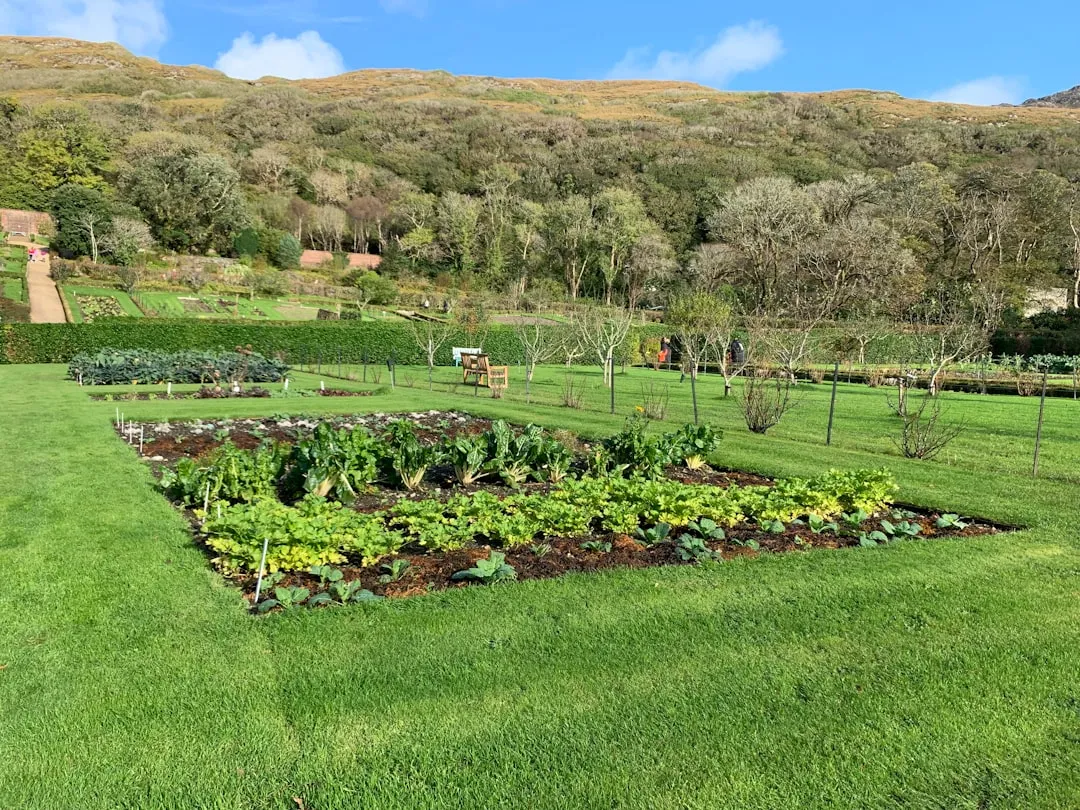
When tractors and other farm machinery were introduced, they usually kept with the traditional style of growing, perpetuating it to the present. That industrial legacy is the single biggest reason home gardeners inherited the straight-row habit even when they have no machinery requiring it. The form outlived its original function.
The spacing on many seed packets refers to traditional rows in gardens, where the rows themselves are quite far apart to allow walking between them or the use of small tractors. So the very instruction guide most gardeners trust is designed around a method built for machines, not for a backyard raised bed where you never walk between plants anyway.
Sun Exposure and Light Interception

Research has shown that planting rows in a diagonal direction can provide numerous benefits. By planting rows in a diagonal direction, plants are able to receive more sunlight throughout the day, which can lead to improved growth and yield. The geometry matters here: when plants are offset, they don’t block each other in the same direct line as the sun tracks across the sky.
Plant density and row spacing configuration is important, as an optimal canopy structure provides the basis for obtaining high yields and can improve the ventilation and light transmission conditions in the field. Too narrow or too wide spacing will lead to an inefficient relationship between population and individuals, resulting in reduced yield. Diagonal spacing finds a natural middle ground that a rigid square grid rarely achieves on its own.
Weed Suppression: A Surprisingly Strong Benefit

Suppression of weed growth in a crop canopy can be enhanced by improving crop competitiveness. One way to achieve this is by modifying the crop planting pattern. Research has addressed the question of to what extent a uniform planting pattern increases the ability of a crop to compete with weeds for light compared to a random and a row planting pattern.
With simultaneous emergence, a uniform planting pattern was eight and fifteen percent more competitive than a row and a random planting pattern, respectively. That research, from Wageningen University, matters. Denser, more uniform canopy closure means weed seeds get less light at the soil surface, and fewer weeds germinate in the first place.
When the vegetables get bigger, their leaves shade the soil, cutting off many weeds and maintaining soil quality from erosion. Less weeds means less weeding. With a diagonal arrangement closing the canopy gap faster, that benefit kicks in earlier in the season.
The Soil Coverage and Erosion Angle

Plant canopy parameters like extent, height, and architecture determine the efficiency of soil erosion control. Soil erosion is a major global environmental problem in terrestrial ecosystems that can impact land productivity, nutrient and carbon cycling, and socio-economic conditions. Establishing plant cover is one of the easiest and most effective ways of controlling soil erosion and regenerating lost soil properties and functions.
A diagonal planting layout, because it closes the canopy gap more efficiently than a square grid, means bare soil patches between plants are smaller and shorter-lived. Planting crops along the contour lines of sloping land reduces surface runoff velocity, increases water infiltration, and minimizes rill and gully formation. The principle applies even at small garden scale when the planted area covers ground more completely.
The Aesthetic Reason It Once Thrived

Victorian gardens were characterized by an eclectic mix of plants sourced globally, showcasing a love for vivid flower colors and unusual foliage. These gardens transformed dramatically, moving from formal, symmetrical designs to more naturalistic landscapes. Diagonal and geometric planting patterns were part of that visual language, used intentionally to create rhythm and depth when viewed across a bed.
Each row offset from the one above by half a spacing means every plant is equidistant from six neighbors instead of four. The same bed holds about fifteen percent more plants, and the planting fills in faster and reads more naturally because the eye does not pick up rows. That last point is underrated. A staggered planting simply looks better, particularly in ornamental beds where the rigid grid can feel mechanical.
The Practical Tradeoffs Worth Knowing

While planting rows in a diagonal direction has many benefits, there are some tradeoffs to consider. Diagonal rows can be more difficult to plant and manage, as they require more precise measurements and may require additional time and effort. That’s an honest caveat. The initial setup does take slightly more planning than dropping seeds along a string line.
Row planting means you can have more space between rows and less space between plants within the row. It makes walking between rows easier and has potential benefits for disease management, but it isn’t as space-efficient as triangular spacing. For very large plots where you need to walk lanes with a wheelbarrow, traditional rows still have a practical edge. The diagonal format shines most clearly in raised beds, bordered vegetable plots, and ornamental borders where full canopy coverage is the goal.
Who Is Still Using It and Why They Should

Gardeners who use staggered rows find they not only offer better yield per yard, but also less work in terms of the application of mulch and fertilizer and in weed removal, with fewer weeds being the norm. Those who stuck with the technique, professional landscapers in particular, have kept it alive because the results are consistent.
For most ornamental plantings, mixed borders, and especially groundcovers, the triangular layout is the default of experienced professional landscapers. The style never truly disappeared from professional practice, it just got filtered out of the home gardening mainstream by the relentless inertia of seed packet instructions and YouTube tutorials showing tidy straight lines.
Time to Revisit an Old Idea

There’s something a little absurd about the fact that a planting arrangement with better space efficiency, stronger weed suppression, improved canopy closure, and arguably better visual appeal gets overlooked simply because a farming method built for tractors shaped how generations of home gardeners think. The diagonal row never failed. It just got crowded out by habit.
The geometry was always right. The seed packet, it turns out, wasn’t designed with your raised bed in mind. Next season, try shifting every other row by half a plant spacing and see what closes in faster, looks fuller, and demands less of your time with the hoe.
AI Disclaimer: This article was created with the assistance of AI tools and reviewed by a human editor.