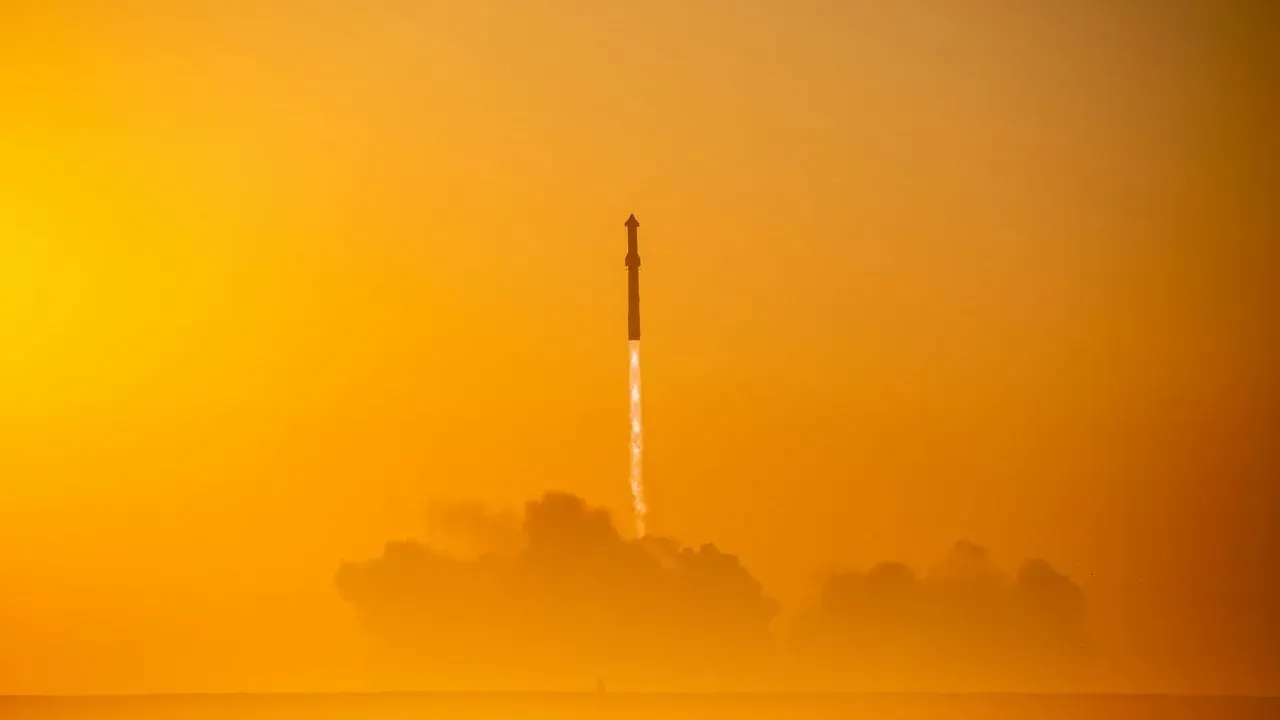

Starbase, Texas – SpaceX sent its Super Heavy-Starship rocket into orbit Monday for the first time, completing the 14th test flight of the vehicle and advancing plans for future NASA missions. The launch from the company’s Texas site lifted the 400-foot-tall rocket off the pad at 8:49 a.m. EDT and placed the upper stage on a path that included six orbits before a planned reentry. The milestone comes after 13 prior suborbital tests and brings the program closer to operational use. ([1])
Launch Sequence and Booster Performance
The Super Heavy booster fired its 33 methane-burning Raptor engines at liftoff, generating roughly 16 million pounds of thrust. The stack climbed southeast along the planned trajectory while shedding propellant mass. Two minutes and 20 seconds after liftoff, the booster began engine shutdown as the Starship upper stage ignited its engines in a hot-staging maneuver. The booster then flipped, restarted engines for a boost-back burn, and executed a controlled splashdown several miles off the Texas coast. Engineers had incorporated upgrades after earlier flights where engine issues limited the return burn. The first stage remains designed for future tower capture, though ocean recovery was used again for this test.
Starship Upper Stage and Satellite Deployment
After separation, the Starship stage performed an initial burn to reach a suborbital path, followed by a second firing that inserted it into a stable 180-mile orbit. Roughly eight and a half minutes later, a dispenser released 26 third-generation Starlink satellites, each offering significantly higher capacity than prior versions. The spacecraft then coasted through six orbits while systems were monitored. A deorbit burn eight hours and 52 minutes after launch set up the final descent. The vehicle reentered belly-first, endured plasma heating, and used fins for control before a tail-down splashdown off Chile after a total mission time of about nine hours and 50 minutes.
Path Toward Artemis Moon Landings
The orbital success supports SpaceX’s role in NASA’s Artemis program, which aims to return astronauts to the lunar surface. A Starship variant is slated to serve as the human landing system, requiring multiple tanker flights to refuel the lander in orbit before it proceeds to the moon. The first crewed landing remains targeted for 2028, though the timeline demands rapid progress on certification and refueling demonstrations. NASA is also funding an alternative lander from Blue Origin as a backup. Multiple launch pads, including new sites in Florida, will be needed to support the high flight rate required for those missions.
AI Disclaimer: This article was created with the assistance of AI tools and reviewed by a human editor.