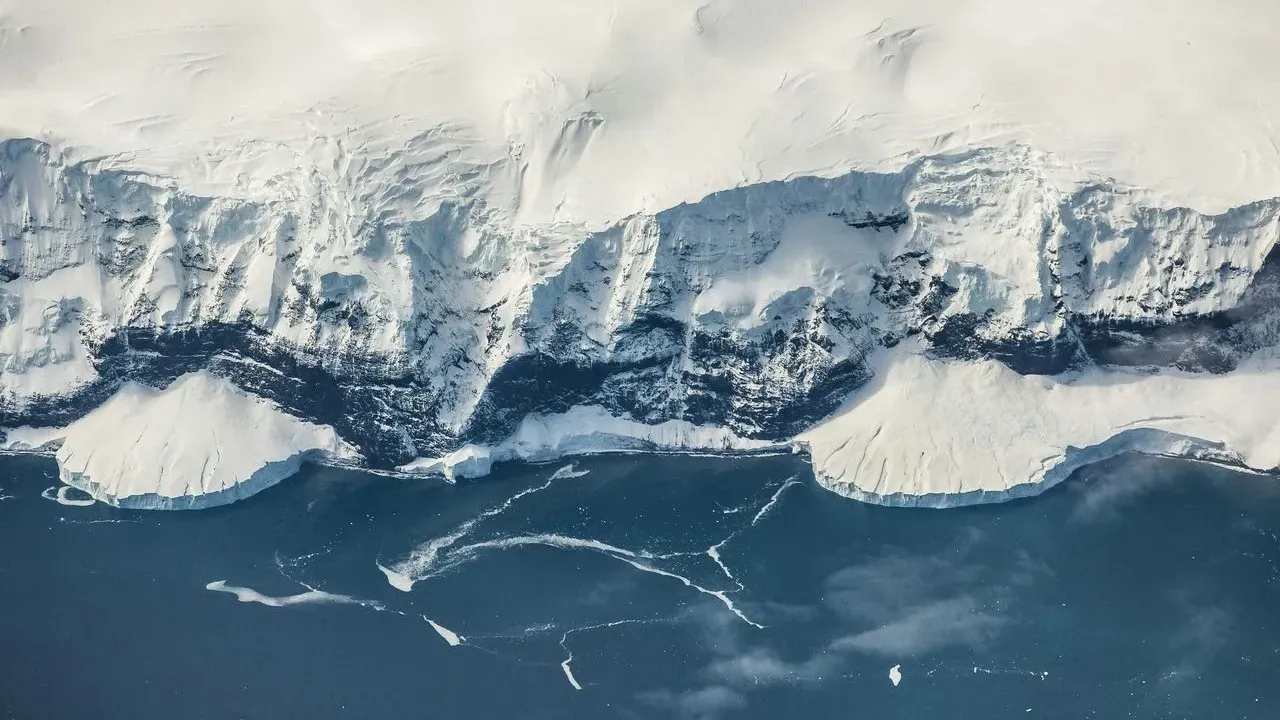

Recent satellite observations have long documented the dramatic retreat of Antarctica’s Pine Island Glacier, one of the continent’s fastest-moving ice streams. A fresh attribution study now quantifies how human-driven warming has intensified that process. The findings indicate that climate change accounts for roughly one-fifth of the glacier’s retreat since the 1940s, adding measurable speed and scale to an already rapid loss of ice. **Why the development stands out now** Pine Island Glacier drains a vast portion of the West Antarctic Ice Sheet and has contributed more to recent Antarctic ice loss than any other single glacier. Satellite imagery captured over decades shows its ice front pulling back steadily, with visible calving events and thinning. The new analysis places those visible changes in a clearer climate context by comparing observed retreat against what models suggest would have occurred without greenhouse-gas emissions. The study marks the first formal attribution effort focused on an Antarctic glacier. Researchers estimate that warming has driven an additional 4 kilometers of retreat – about 18 to 20 percent of the total since the mid-20th century. That increment may appear modest in absolute terms, yet it arrives on top of an already swift natural retreat, pushing the glacier farther and faster toward deeper, more unstable terrain. **How satellite imagery captured the pace of change** Long-term satellite records reveal consistent patterns. Images from instruments such as Landsat and MODIS illustrate the ice front’s position shifting inland by tens of kilometers over two decades alone. These visuals show not only the distance covered but also the increasing frequency of large iceberg calving and the widening of rifts across the floating ice shelf. Such imagery supplies the observational backbone for the attribution work. By anchoring model simulations to these documented positions, scientists could isolate the portion of retreat attributable to human influence. The result is a clearer separation between background variability and the added effect of rising global temperatures. **What the attribution study adds** The research team ran climate-model experiments with and without anthropogenic forcing. The difference between the two scenarios points directly to the extra retreat linked to emissions. Lead author Dr. Bradley summarized the outcome: “Our results show that climate change made the retreat of the Pine Island Glacier substantially worse.” The added retreat matters because Pine Island Glacier sits on bedrock that slopes downward inland. Once the grounding line – the point where ice lifts off the seabed – moves past certain ridges, further retreat can accelerate even without additional warming. The study suggests climate change has already nudged the glacier closer to or across some of those thresholds. **Broader implications for sea-level rise** Pine Island Glacier has accounted for roughly a fifth of net ice loss from the West Antarctic Ice Sheet over recent decades. That ice sheet, in turn, has driven nearly all of Antarctica’s contribution to global sea-level rise in the past forty years. Any acceleration in its retreat therefore carries direct consequences for coastal planning worldwide. The new percentage may seem small, yet it compounds over time. Continued emissions would likely enlarge the human share of future retreat, while emissions reductions could limit how much farther the glacier is pushed. Satellite monitoring will remain essential for tracking whether those limits are respected. **Looking ahead** Ongoing satellite missions continue to deliver higher-resolution data on ice thickness, flow speed, and ocean temperatures beneath the ice shelf. Combined with attribution techniques, these observations help refine projections for when and how quickly additional ice loss may occur. The Pine Island Glacier case now stands as a benchmark for understanding how climate change interacts with Antarctica’s most dynamic outlets.
AI Disclaimer: This article was created with the assistance of AI tools and reviewed by a human editor.