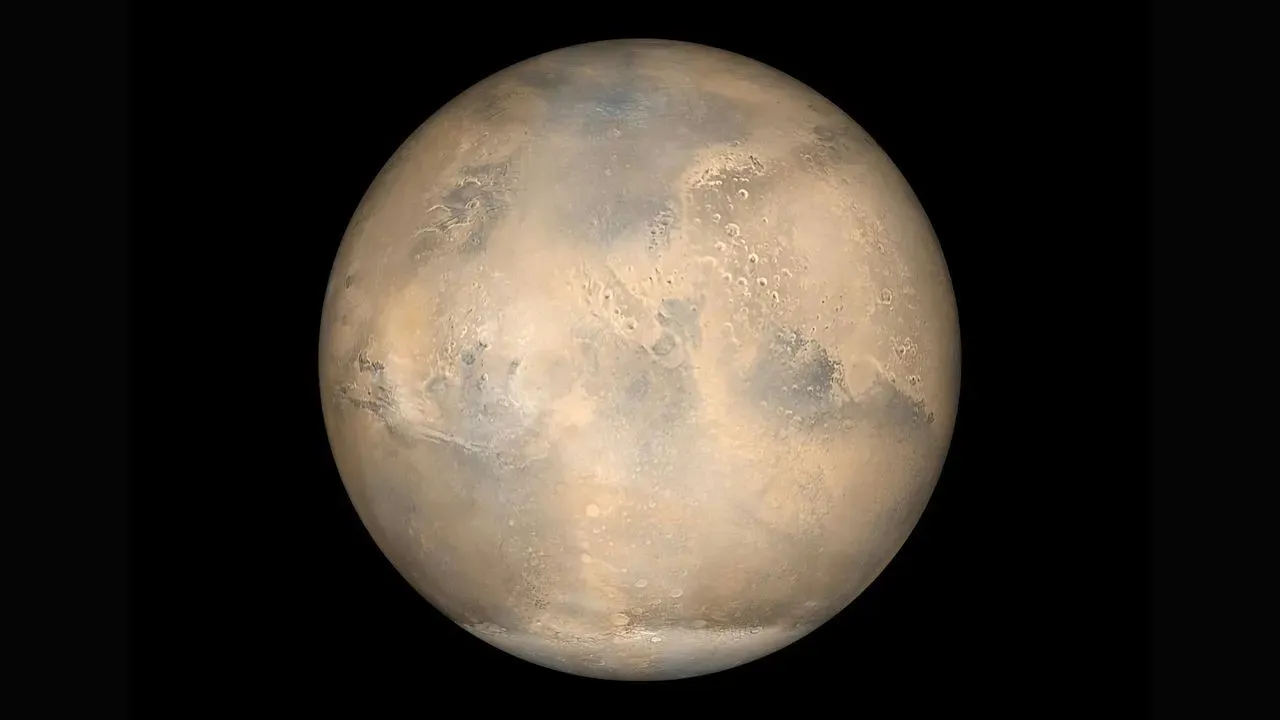

Space scientists have identified an unexpected process behind one of the Red Planet’s most distinctive atmospheric features. New modeling of the Arsia Mons Elongated Cloud shows that its formation depends on conditions and mechanisms long considered theoretical rather than observed in nature. The findings, drawn from data collected by the European Space Agency’s Mars Express spacecraft, add a fresh layer to understanding how clouds behave on Mars and potentially on other worlds. ([1])
A Daily Spectacle Above an Ancient Volcano
The cloud in question stretches up to 1,800 kilometers in length, emerging each morning above Arsia Mons, a towering extinct volcano in the Tharsis region near the Martian equator. It grows rapidly in the early hours before dissipating within a couple of hours, only to repeat the cycle for several months during the planet’s southern spring and summer. This elongated shape and strict daily rhythm set it apart from more familiar cloud types seen on Earth or elsewhere on Mars.
Researchers have tracked the feature for years using orbital imagery. Its consistent appearance and scale have made it a focal point for atmospheric studies, yet standard explanations involving dust particles as condensation nuclei fell short when tested against observations. The cloud’s behavior demanded a closer look at the underlying conditions in the thin Martian air.
Why Standard Cloud Formation Falls Short
On Earth, water vapor typically needs tiny particles such as dust, pollen, or salt to serve as surfaces where ice crystals or droplets can form. Mars carries abundant fine dust that scientists long assumed played a similar role in cloud development. Models incorporating those particles, however, could not reproduce the Arsia Mons cloud’s distinctive length, timing, or rapid daily cycle.
The mismatch prompted the team to explore rarer atmospheric states. Extremely high levels of water vapor saturation, far beyond what is common in planetary environments, appear necessary. Under those conditions, the vapor can bypass the usual need for nuclei and transition directly into ice particles.
Homogeneous Nucleation Emerges as the Key
The process identified is known as homogeneous nucleation. In this pathway, water vapor converts straight into icy cloud particles without an intermediate surface or foreign material. Lead author Jorge Hernández-Bernal described the requirement: “To create the AMEC in our modelling, we found that we needed to include some exotic physics… physics that, while included in textbooks, is treated as theoretical and usually thought not to happen in nature. It certainly hasn’t been seen in action before.”
The same researcher offered a clear analogy for the direct transition: “Water vapour turns directly into icy cloud particles without any middle step. It’s akin to droplets of condensation appearing in the middle of a room, rather than on a window.” Such extreme humidity levels, exceeding typical Earth values by orders of magnitude, make the mechanism possible only under very specific Martian circumstances.
Previous theories had suggested homogeneous nucleation might occur in the upper atmospheres of Earth or Venus, yet no direct evidence had been recorded in any planetary setting until this modeling effort. The result underscores how Mars’ unique combination of low pressure, temperature swings, and seasonal water vapor spikes can produce atmospheric behavior not replicated elsewhere in the solar system.
What the Discovery Means for Planetary Science
The study, published in Nature Geoscience, demonstrates that familiar physical rules can yield unfamiliar outcomes when applied to different planetary environments. ESA Mars Express Project Scientist Colin Wilson noted that while clouds on Earth and Mars follow the same basic principles, explaining this particular feature required invoking processes previously viewed as exotic. That insight may prove useful when interpreting observations of atmospheres on distant exoplanets.
Future missions equipped with more sensitive instruments could test the model further by measuring local humidity and particle formation in real time. For now, the work highlights the value of combining long-term spacecraft data with advanced simulations to uncover processes that textbooks describe but nature rarely displays.
The Arsia Mons cloud thus stands as a reminder that planetary atmospheres can still surprise researchers even after decades of observation. Its odd character stems not from dramatic events but from the quiet operation of physics pushed to an extreme rarely encountered elsewhere.
AI Disclaimer: This article was created with the assistance of AI tools and reviewed by a human editor.