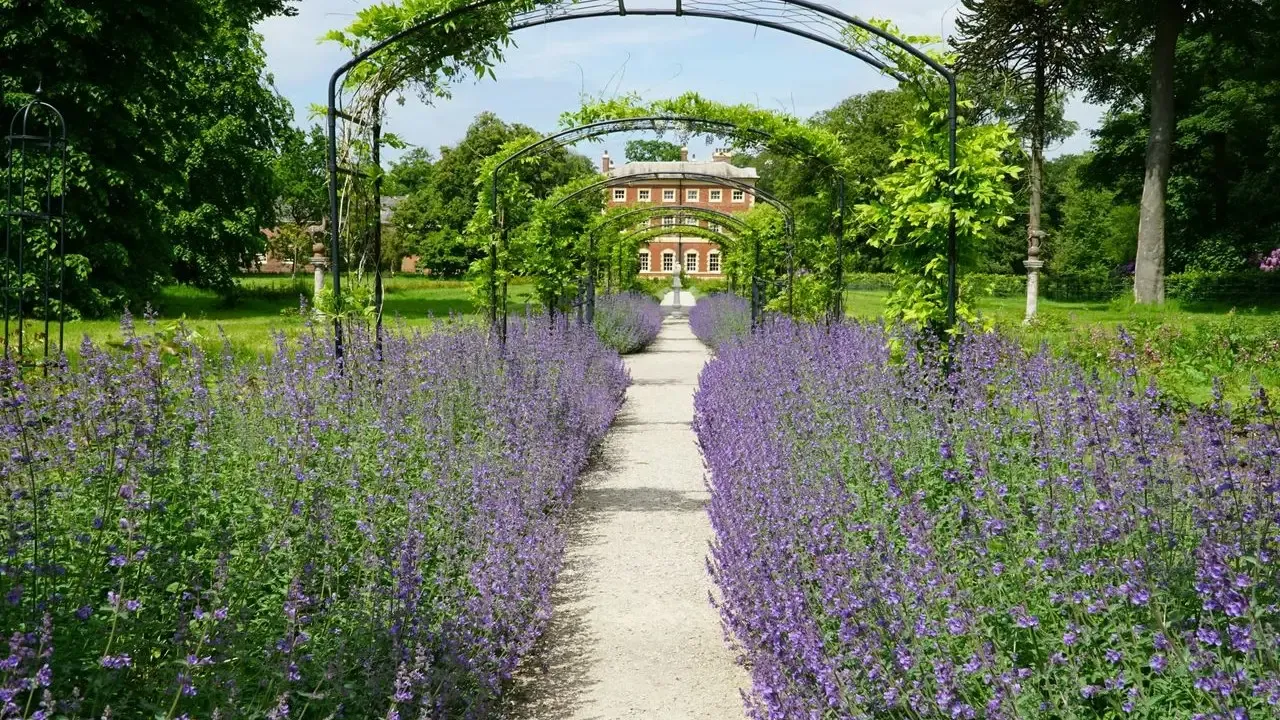

Most borders are planned around a simple rule: choose plants that flower at different times and something will always be in bloom. A border at Doddington Place Gardens in Kent works on a more ambitious plan, with its colour gathering toward a clear high point. A feature on The Middle-Sized Garden ([1]) uses this approach to show how the idea can be adapted. For home gardeners working with limited space, the lesson is more practical than it first appears.
A garden shaped around a single peak
Doddington Place sits on the edge of Doddington village, near Faversham, as part of an Edwardian estate. Doddington Place Gardens is part of a 850 acres Edwardian estate, located on the edge of Doddington village, near Faversham in Kent, UK. The original layout came from Markham Nesfield, father of the famous designer William Nesfield, and consist of 10 acres of beautiful landscaped gardens.
The gardens have a long record of public access. The gardens have been open in aid of the National Gardens Scheme for more than fifty years. Their planting has also changed over time. The eight beds and borders around the formal pond were redesigned in 2010 by Kirsty Knight Bruce, and they are arranged to provide a succession of blooms through the seasons, from massed tulips, through alliums and roses to a wide variety of herbaceous plants.
Where the crescendo takes place
The climax of the planting falls in early summer. The densely planted herbaceous border reaches a crescendo of colour in late June with spires of delphiniums, white lilies, golden achilleas and rich blue salvias, all carefully planned out with an exuberant result. The effect depends on that planning. Plants are chosen and placed so their peak height and colour arrive together, rather than in a gradual relay.
The garden’s later months follow a different mood. The sunken garden is the star of the show from high summer into autumn. The late summer sees the prairie-planted Sunk Garden in full sail. The style draws on naturalistic planting influenced by gardeners such as Piet Oudolf of the New Perennial Movement.
Lessons a smaller border can borrow
The design principles translate well to a modest plot. Several points stand out from the wider guidance on garden borders:
- Choose one memorable colour for each season. If you can have one memorable colour in the border in every season, for example tulips or alliums, then you’ll have a very successful border.
- Start with bulbs, then build the backbone. She starts out with bulbs. Then the perennials create the backbone of the border.
- Plan for late-season flowers. Later in the year, rudbeckia, asters (symphyotrichum), penstemon, nerines, Japanese anemone and sedum take over the flowering baton.
- Edit in August. August is a good month to edit your borders. By that time everything is as big as it’s going to get.
What matters now: A border that builds to a peak is planned as a whole. Bulbs, perennials, late-season plants and seasonal editing all work toward one moment of colour, and a well-planned plot of modest size can achieve it.
The Doddington example suggests that a crescendo is less about buying more plants and more about timing them. A brilliant border can be achieved by amateur gardeners in middle-sized gardens. For gardeners willing to plan the sequence and hold back some colour for the peak, the reward is a border that feels like it is building toward something.
AI Disclaimer: This article was created with the assistance of AI tools and reviewed by a human editor.