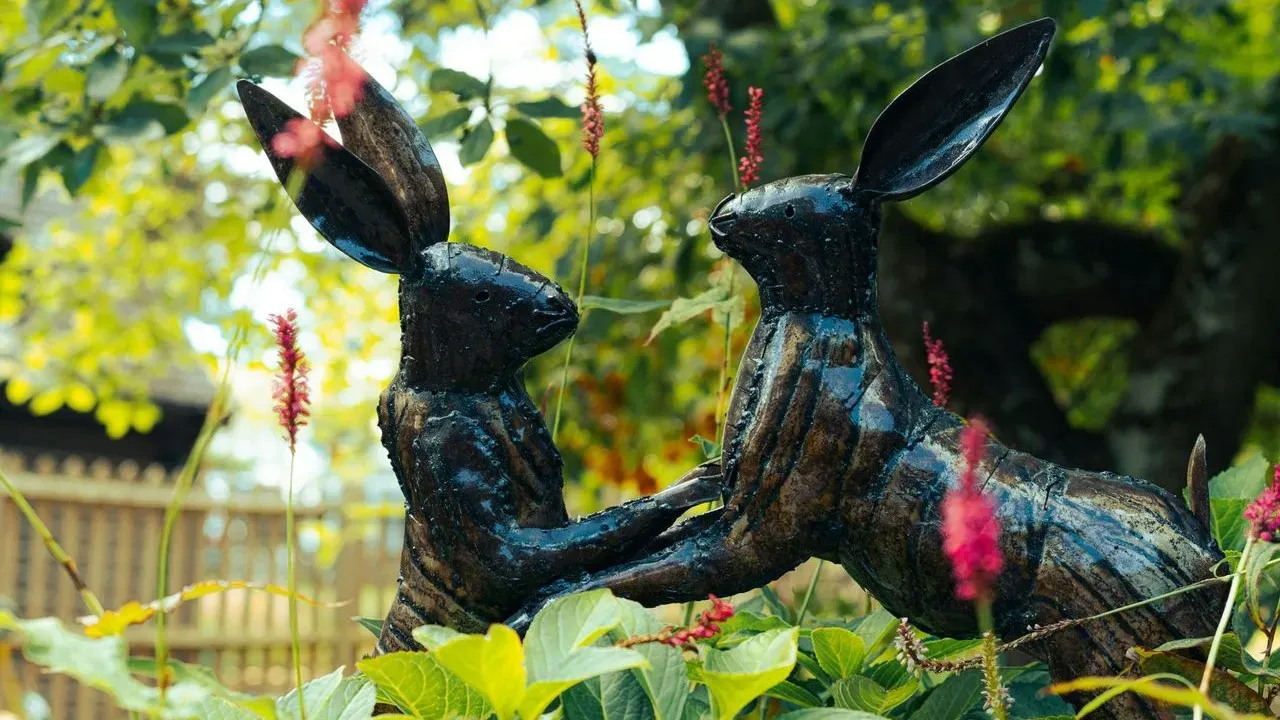

East Hampton, New York – Sculpture and living plants rarely share a landscape as openly as they do at LongHouse Reserve. The property began as the home and garden of Jack Lenor Larsen, and it now functions as a public garden and sculpture collection ([1]). Fine Gardening revisited the site through its Garden Photo of the Day archive, and the visit shows how the artworks and the plantings influence one another.
Art That Frames the Landscape
Buckminster Fuller’s Fly’s Eye Dome may be the most striking work on view. Its honeycomb structure acts as a lens, so visitors see the surrounding garden through its openings rather than past it. The sculpture makes the plantings feel like part of a composed picture.
Another piece takes its cue from the Brooklyn Bridge. Late sunlight drops through the bamboo behind it, which gives the work a backdrop that changes with the time of day. The pairing shows how the garden treats art and plants as one composition rather than separate features.
A Red Garden That Plays With Distance
The Red Garden offers one of the most instructive design details on the grounds. The walkway starts broad at the top and tapers toward its far end, while the red posts that line it shorten as they descend. The arrangement creates a false sense of perspective, making the view look considerably longer than it actually is.
The effect appears to be most dramatic when the plants are at their peak. A separate visit in May 2022 found the foliage especially vivid in this area, where two rows of red posts led toward an arcade of bright red shrubs ([2]). For home gardeners, the trick is simple to borrow. A path that narrows and a line of diminishing posts can make a modest space feel deeper.
- Fly’s Eye Dome frames views of the garden in a honeycomb pattern.
- The Red Garden uses tapering paths and shrinking posts to suggest depth.
- Soil from a pond excavation shaped the dunes and hills.
- Pruned bamboo became a pagoda beneath tall trees.
Reuse, Seasons and Winter Light
The garden also follows a clear principle of reuse. Soil removed while digging a pond was used to build dunes and hills, and bamboo pruned from the property’s many stands now forms a pagoda under mature trees. Materials that might have been discarded become structural elements, which gives the site a practical as well as an artistic logic.
Timing matters here as well. A former Garden Photo of the Day editor visited in January, when bare branches left the sculptures and the garden’s framework exposed. Strands of white tassels hanging in trees near the house caught the low winter sun. The visitor observed that a single tassel would have looked accidental, while many together appeared deliberate. Because the garden changes so much between seasons, the same paths and sculptures can read very differently in winter and spring.
Taken together, the site offers a clear example of how sculpture can serve as a structural part of a garden rather than an ornament placed within it. The Red Garden’s optical trick and the reuse of pond soil and bamboo show that thoughtful design can be as memorable as a striking artwork.
AI Disclaimer: This article was created with the assistance of AI tools and reviewed by a human editor.