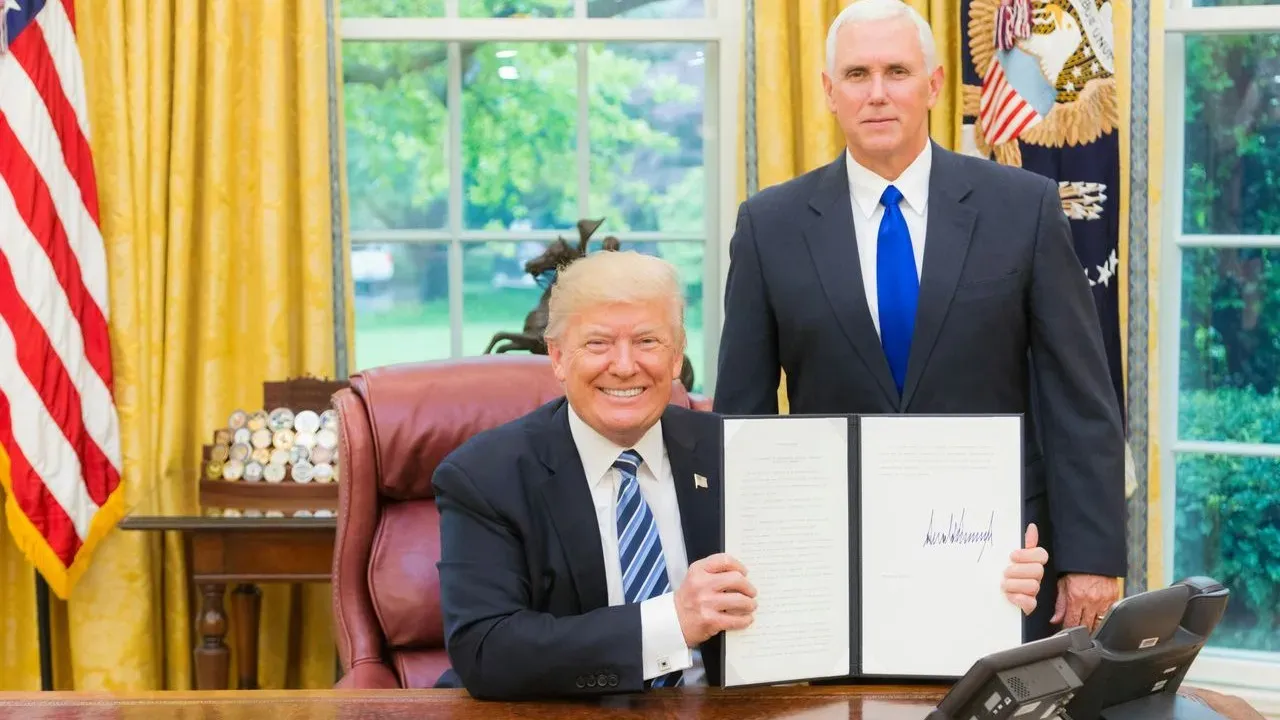

When a cash total lands between nickels, grocery cashiers have often had little choice but to round it. President Donald Trump has now signed the bipartisan Common Cents Act, which sets federal rules allowing retailers to round cash transactions to the nearest nickel. The law responds to a shortage that has deepened since ([1])penny production ended in 2025, leaving stores short of the one-cent coin.
A coin that has stopped being made
The shortage has landed hardest on businesses that handle large volumes of cash. Supermarkets and other cash-heavy retailers have struggled to give exact change as their penny supplies dwindle, and the problem has become a routine checkout headache. The legislation also gives those businesses legal protection when they follow its rounding procedures.
Cash has not disappeared from daily life, even as electronic payments take a growing share of retail sales. That matters most during the holiday season, when stores see heavy traffic and long lines. Predictable rounding rules give both clerks and customers a common expectation at the register.
What the law changes, and what it leaves alone
The measure creates a uniform federal framework for rounding cash when pennies are unavailable. Before it, retailers could face conflicting demands from state, local and tribal penny-rounding requirements, as well as the equal-treatment provisions tied to the Supplemental Nutrition Assistance Program. The new framework offers a safe harbor from those conflicts for retailers that follow the rounding steps spelled out in the law.
The law has clear limits, however. It does not restore penny production, and it does not pull pennies already in circulation out of use. The table below summarizes the shift in practical terms.
| Issue | Before the law | Under the law |
|---|---|---|
| Rounding rules | Possible conflicts between state, local, tribal and federal expectations | A uniform federal framework for rounding cash |
| SNAP equal treatment | Retailers risked conflicts with equal-treatment provisions | Safe harbor for retailers that follow the law’s procedures |
| Penny supply | Production ended in 2025 and supplies keep shrinking | No change, since the law does not restore production |
Grocers and trade groups respond
FMI, the Food Industry Association, and the National Grocers Association both welcomed the legislation. They described it as a necessary answer to a checkout problem that has become more common. Christine Pollack, FMI vice president of government relations, said the bill resolves confusion for customers while easing operational strain on grocers and other Main Street businesses.
The concern carries extra weight for independent supermarkets, which must keep checkout procedures consistent while meeting several layers of regulation. Stephanie Johnson, NGA senior vice president and head of government affairs, called the disappearance of the penny “a very practical problem at the checkout counter.” She said the law offers the clarity and legal protection retailers need to handle cash fairly and consistently.
Sponsors and the road ahead
The bill was sponsored by Sens. Cynthia Lummis, a Republican from Wyoming, and Kirsten Gillibrand, a Democrat from New York. Reps. Lisa McClain, a Republican from Michigan, and Robert Garcia, a Democrat from California, also backed it. The House and Senate approved the measure earlier this fall before the president signed it.
NGA credited its government affairs team with a yearlong advocacy effort, while FMI thanked Trump for signing the bill ahead of Thanksgiving. For shoppers, the change is likely to be quiet but practical. Cash payments will follow a standard rounding method, while the broader penny supply continues to decline.
AI Disclaimer: This article was created with the assistance of AI tools and reviewed by a human editor.