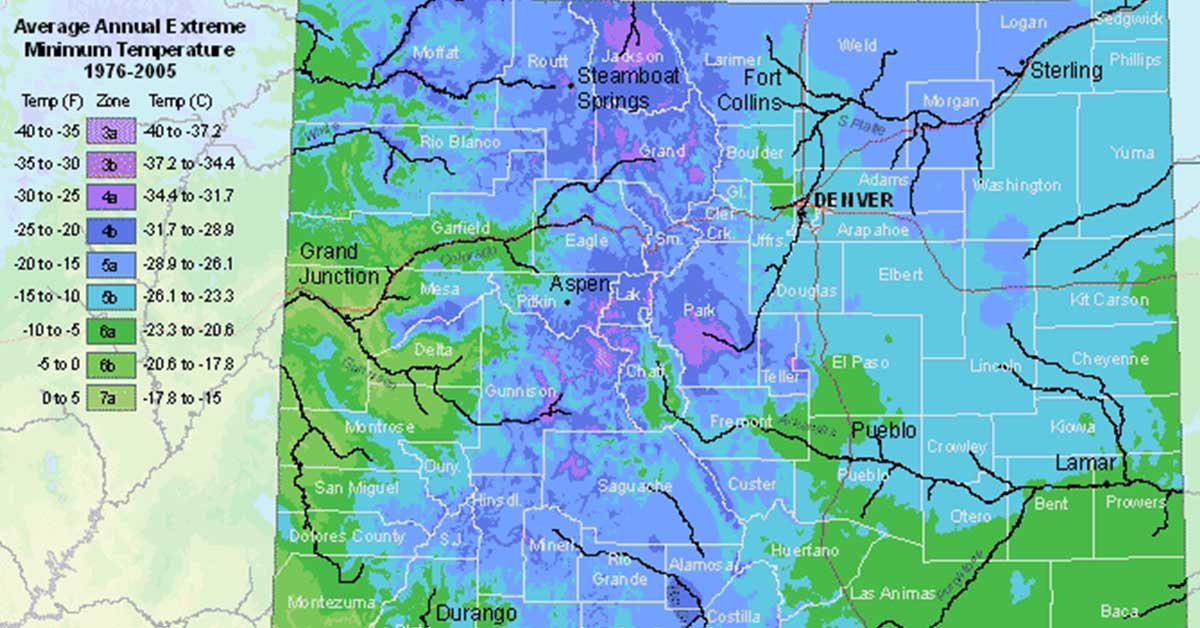

The United States Department of Agriculture (USDA) developed the Plant Hardiness Zone Map to help gardeners, farmers, and landscapers determine which plants are most likely to thrive at a location. This classification system plays a crucial role in defining an area’s microclimate related to plant life and agriculture, including in Colorado Springs.
Each zone in the map is defined by the average annual minimum winter temperature, divided into 10-degree Fahrenheit zones. In total, there are 13 primary hardiness zones, ranging from the extremely cold Zone 1 (below -50 degrees Fahrenheit) to the tropical Zone 13 (above 60 degrees Fahrenheit). Each of these zones is also divided into two sub-zones (a and b) that differ by 5 degrees Fahrenheit.
Identifying the USDA Hardiness Zone of Colorado Springs, Colorado
According to the USDA Hardiness Zone Map, Colorado Springs, Colorado falls into Zones 5a to 6a. This implies that the average annual minimum winter temperature ranges from -15 to -10 degrees Fahrenheit in Zone 5b, and -10 to -5 degrees Fahrenheit in Zone 6a.
The existence of the three zones within the city can be attributed to the area’s varied topography. Colorado Springs is situated near the eastern foot of the Rocky Mountains and is over a mile above sea level, creating a landscape that is both hilly and flat. This geographical diversity contributes to distinct microclimates within the city. Higher elevations in the city, such as the Cheyenne Mountain, tend to fall in the colder Zone 5b, while the lower areas like downtown Colorado Springs typically fall in the warmer Zone 6a.
Implications for Gardening and Agriculture
The hardiness zones play a critical role for both home gardeners and commercial farmers, as it provides essential guidance on what plant species can successfully grow in an area. For Colorado Springs, the 5b to 6a hardiness zone implies a moderately cold winter climate, which affects the plant species that can successfully overwinter outside.
A wide variety of plants can thrive in these zones, including evergreen trees like Colorado Blue Spruce and Ponderosa Pine, shrubs like the Rocky Mountain Juniper, and flowers such as the Colorado Columbine and the Rocky Mountain Penstemon. Gardeners can also grow a variety of fruits and vegetables, such as apples, cherries, spinach, and kale.
It’s important to remember, however, that the USDA hardiness zones only provide guidance on a plant’s ability to survive the winter. Other factors like summer heat, soil type, moisture availability, and wind exposure can also significantly impact a plant’s health.
Native plants that grow in Colorado Springs
Native plants are those that occur naturally in a region without human intervention. They are adapted to local soil, precipitation, and temperature conditions, making them a great choice for sustainable landscaping. For Colorado Springs, situated in USDA Hardiness Zones 5b to 6a, the following native plants are well-suited:
- Colorado Blue Spruce (Picea pungens): This evergreen tree is the state tree of Colorado. It’s adapted to the region’s climate and does well in both full sun and partial shade.
- Ponderosa Pine (Pinus ponderosa): A native conifer of Colorado that is resilient and drought-tolerant, which makes it a good choice for xeriscaping.
- Rocky Mountain Juniper (Juniperus scopulorum): This versatile shrub thrives in many soil types and conditions, from well-drained soils to rocky slopes.
- Big Sagebrush (Artemisia tridentata): A drought-tolerant shrub that is commonly found in the region, sagebrush provides food and habitat for local wildlife.
- Colorado Columbine (Aquilegia caerulea): The state flower of Colorado, this plant thrives in well-drained soils and partial shade, producing distinctive white and lavender flowers.
- Rocky Mountain Penstemon (Penstemon strictus): This perennial plant produces beautiful blue-purple flowers and is highly resistant to drought.
- Scarlet Gilia (Ipomopsis aggregata): A biennial or short-lived perennial, this plant attracts hummingbirds with its red tubular flowers.
- Prairie Coneflower (Ratibida columnifera): This sun-loving, drought-tolerant plant blooms from early summer to fall, showcasing a distinctive red and yellow flower.
- Blue Grama Grass (Bouteloua gracilis): A warm-season grass that is the state grass of Colorado, it is drought-tolerant and grows well in a variety of soil conditions.
- Pasque Flower (Pulsatilla patens): Blooming in early spring, often before the last snow melts, the pasque flower is known for its silky, bell-shaped lavender flowers.
Remember, these native plants not only add beauty to your garden, but they also play a critical role in supporting local ecosystems by providing habitat and food for wildlife, from pollinators like bees and butterflies to birds and mammals.
Final Thoughts
The USDA Hardiness Zones of Colorado Springs are 5b and 6a. This classification helps residents and agriculturalists determine the types of plants that can thrive in the area, thus optimizing gardening and farming practices. However, the hardiness zone is not the sole determinant of a plant’s success in a particular area, and gardeners should also consider factors like summer heat, soil condition, and moisture levels when deciding what to plant. Understanding these zones and their implications can unlock the potential of a region’s flora, enhancing the beauty and productivity of our landscapes.