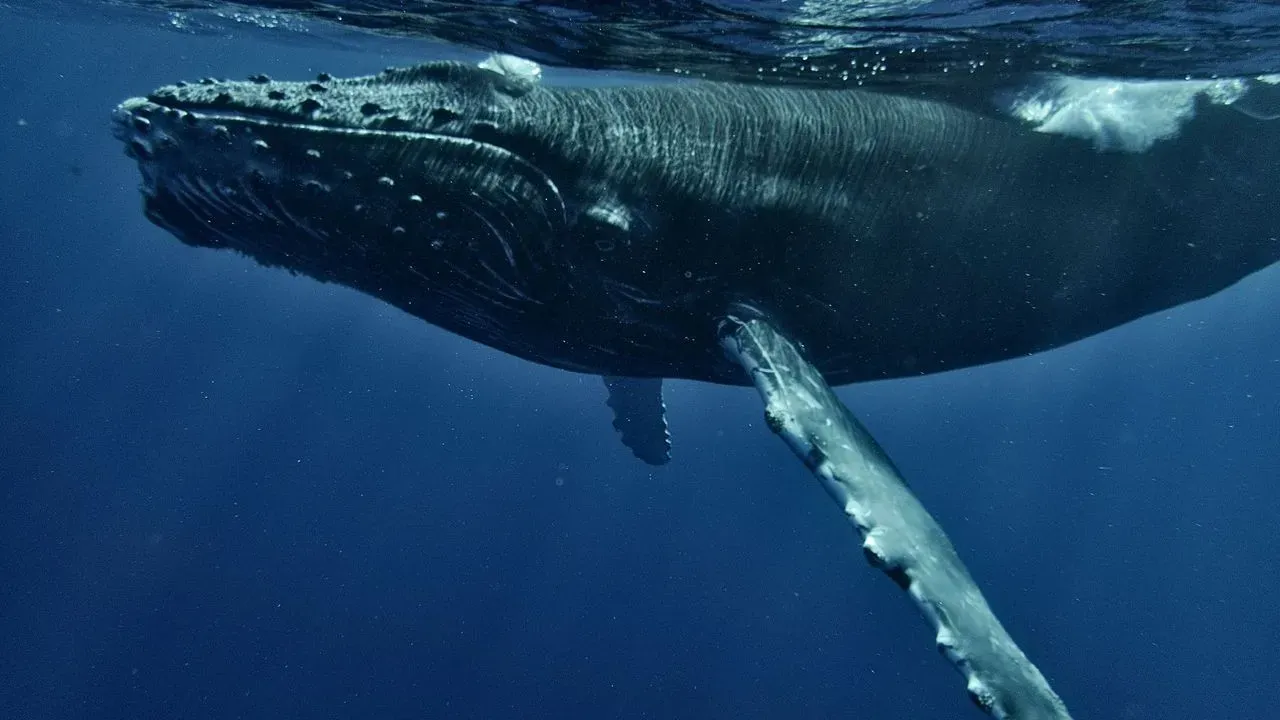

Off the coast of New York and New Jersey, a one-year-old right whale is moving north through some of the busiest shipping water on the Atlantic seaboard. A newly released animated video traces the animal’s route and shows how many vessels it must avoid along the way ([1]). The animation makes a difficult point clear. This is a species with very little room for error, and only about 380 North Atlantic right whales are believed to remain.
A crowded corridor for a young animal
The threat is not hypothetical. NOAA says that large ships use major ports, including those in New York and New Jersey, at the same times right whales are feeding, migrating, or calving ([2]). For a young whale still learning the coast, that overlap is a daily navigation problem.
The video also has limits. It displays only vessels equipped with Automatic Identification Systems, so boats without that technology do not appear. The number of ships shown is therefore a floor rather than a full count of the traffic around the animal.
Few animals, and fewer breeding females
The stakes extend well beyond a single whale. NOAA estimates the population at approximately 380 individuals, and only about 70 of them are reproductively active females ([2]). Every surviving calf therefore carries outsized weight for the species.
There has been some encouraging news. Researchers documented 23 calves during the 2025-26 calving season, the highest number since 2009, according to a report on a right whale returning to South Carolina waters with a newborn ([3]). Still, a few strong seasons do not offset the losses from collisions and entanglements, which remain the two major causes of death.
The speed rule at the center of the debate
The main safeguard on the water is the Vessel Speed Rule, first put in place in 2008. It requires boats 65 feet or longer to slow to 10 knots in designated seasonal areas along the East Coast ([4]). Slower speeds give both whales and captains more time to react, and a 2013 study found that reducing speed could cut whale deaths from ship strikes by as much as 90 percent ([5]).
Compliance appears to be relatively high. NOAA’s data indicates that most vessels follow the mandatory limit, although the agency has acknowledged that some ship strikes still occur. The rule has been part of the coastal routine for more than a decade, which makes any change a significant decision for mariners.
A rule under review
That routine is now under review. On March 4, 2026, NOAA issued an advance notice of proposed rulemaking that considers modifying the speed rule ([6]). The agency has framed reduced speed as one of several ways to prevent strikes, and it has asked the public for input on possible revisions.
The stakeholders disagree about what should replace or supplement the rule. Shipping and recreational boating interests have long pushed to weaken speed limits, and one boating trade group argues that monitoring and detection technology is enough. Conservation groups counter that technology should add to the speed rule, not replace it. Four organizations, including the Conservation Law Foundation and Defenders of Wildlife, have asked to defend the rule in court.
For now, the existing requirements remain in force. Federal 10-knot speed zones are scheduled to return on November 1 along the coast from Rhode Island to Georgia. Any change would still require a proposed rule and another round of public comment before it takes effect.
What the migration route reveals
The young whale’s journey shows why the debate matters. Its path crosses ports, shipping lanes, and recreational traffic, and each season’s decisions determine how much room it has. The rule set for this winter is the 2008 version, and the next steps will show whether the coast keeps slowing down for a species that numbers only in the hundreds.
AI Disclaimer: This article was created with the assistance of AI tools and reviewed by a human editor.