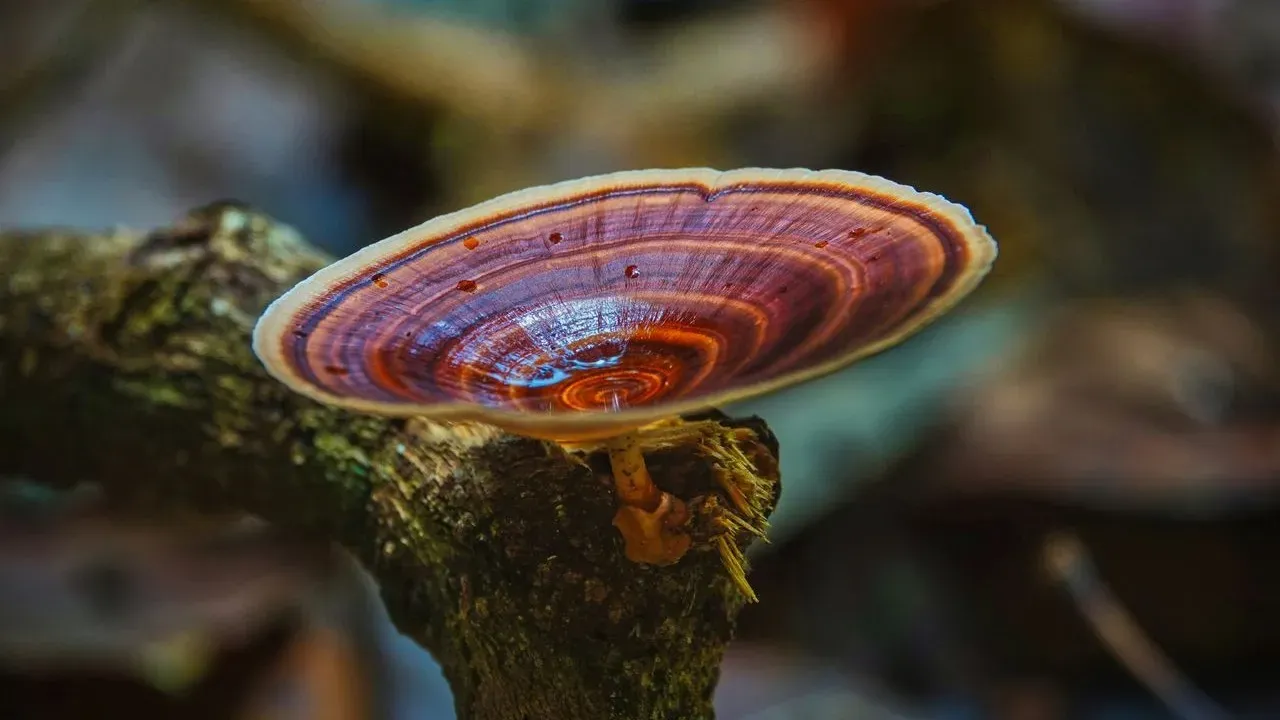

Few mushrooms carry a reputation as long as reishi. An adapted excerpt from The Mycelial Healer by Christopher Parker and Katherine Parker, published by Chelsea Green Publishing, traces the fungus from ancient Chinese medicine to present-day laboratory and clinical research ([1]). Interest in the mushroom is growing among home growers and people seeking natural wellness options, and the claims attached to it range from promising to unproven.
A Shiny Shelf Fungus With a Telling Name
Reishi belongs to the genus Ganoderma, and its Latin root refers to shiny skin. The glossy caps of these shelf fungi look almost varnished, which is why some people also call them Varnish Shelf. The mushrooms release rusty brown spores under strong pressure, and the spores settle in thick layers on nearby caps. Only a modest share of those spores germinate, roughly half by one estimate.
Reishi also plays a role in forest ecosystems. It is a white rot fungus that breaks down lignin and leaves behind pale, fibrous cellulose. Some Ganoderma species act as decomposers that return woody material to the soil, while others are parasites that can kill trees. The genus includes many species that grow across the eastern woodlands of North America, as well as species that attack palm trees along southern coasts.
Two Thousand Years of Traditional Use
Reishi has been part of Chinese medicine for at least two thousand years, and the source suggests its use may be considerably older. The mushroom appears in texts that date to around 100 BCE. Its Chinese name, Lingzhi, is often rendered as “The Mushroom of Immortality” or “The Divine Mushroom,” which explains the nickname that still follows it.
Traditional texts sorted Ganoderma species into six categories by color, and each color was linked to particular organs or ailments. The mushroom also shows up in art. The source points to an eighteenth-century Chinese soapstone carving of Guanyin that includes reishi, now held by the Metropolitan Museum of Art in New York City, as well as wall paintings in a nineteenth-century Scottish home.
What the Studies Show, and Where They Fall Short
Laboratory and preclinical work has examined reishi for anticancer, antiviral, antibacterial, and anti-inflammatory activity, along with possible benefits for heart health and diabetes. Human trials are more limited, and their results vary. The source notes that researchers generally regard reishi as a possible adjunct therapy for cancer, one that may slow tumor growth and improve quality of life. It does not present reishi as a standalone treatment, and it does not claim the mushroom can cure cancer.
Blood pressure offers a useful example of mixed findings. In one study of people with mildly elevated blood pressure and cholesterol, participants saw improvements in beneficial cholesterol and insulin markers, but blood pressure did not change significantly. The same source describes a ninety-day trial in people with atrial fibrillation in which a daily dose of a reishi-derived compound was linked to improved systolic blood pressure, though that trial was small and specific to one condition. The following table summarizes the main areas discussed.
| Area | Reported finding | Caveat |
|---|---|---|
| Cancer | Slower tumor growth and better quality of life in some patients | Used as an adjunct, not a standalone treatment |
| Diabetes | Two trials produced conflicting results | Differences in extracts and doses may explain the gap |
| Fibromyalgia | A trend toward better mood and reduced pain | Based on a limited number of patients |
Diabetes research illustrates how hard the picture is to read. Of two tightly controlled studies, one found a significant benefit while the other found none. The positive study used a patented extract at a much higher daily dose, which suggests that preparation and dosage could account for the difference. More research is needed before firm conclusions can be drawn.
Growing and Harvesting Reishi Responsibly
Reishi is one of the most cultivated mushrooms in the world, and the source says it can be grown with relative ease. Growers often use sawdust in controlled environments, where carbon dioxide levels can be adjusted to encourage the formation of antler-like growths. Outdoor growers can partly bury small logs horizontally or bury larger logs vertically, a method the authors describe as the most consistent way to obtain the mushroom.
Wild harvesting raises different concerns. Hemlock Reishi, for example, thrives on hemlock trees dying from the Hemlock Woolly Adelgid, an insect infestation. Its abundance depends on those dying trees, and the authors warn that the species may need to shift to other hosts once the hemlocks are gone. They also caution against harvesting too early or taking everything in sight. For scarcer Golden Reishi, the recommendation is to pick a small share and leave the rest to reproduce.
What matters now: reishi has a long history in traditional medicine and a growing body of lab and clinical research. The evidence for specific health benefits remains mixed, and the source does not present reishi as a cure for any disease. Growers who want the mushroom can cultivate it at home, while foragers are urged to protect wild populations.
Reishi’s appeal rests on centuries of use and a growing research base, yet its benefits are still being measured. For gardeners, the mushroom offers a patient project that rewards careful cultivation. For readers interested in its health effects, the most useful approach is to weigh each study by its size, dose, and design before drawing conclusions.
AI Disclaimer: This article was created with the assistance of AI tools and reviewed by a human editor.