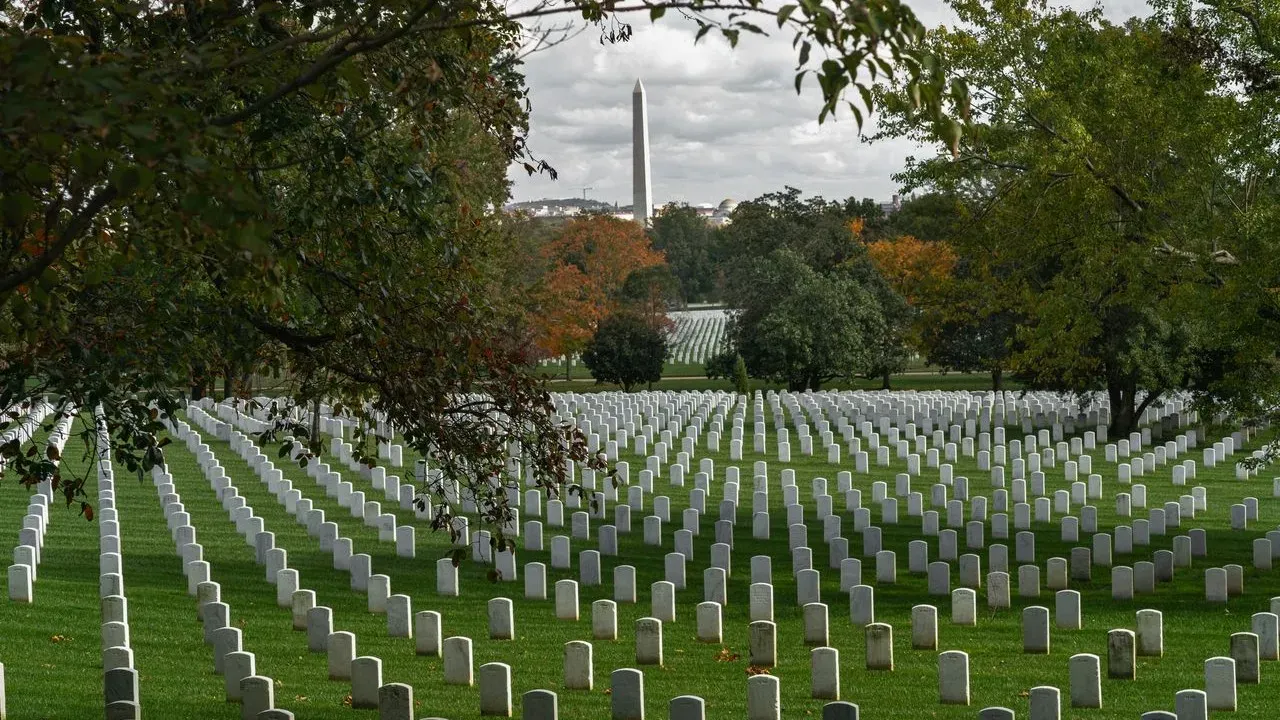

Near the rows of white headstones at Arlington National Cemetery, one Marine’s grave faces the rising sun and the Lincoln Memorial across the Potomac River. A 250-foot arch proposed by President Donald Trump could soon stand within sight of that view. The plan has drawn strong objections from veterans and grieving families who worry about shade, construction noise and the historic setting of the nation’s capital. ([1])
A monument taller than the Lincoln Memorial
The structure would rise at Memorial Circle, a traffic circle about half a mile from the cemetery’s main entrance. Renderings released earlier this year show a gold-and-white design topped by a gilded statue of Lady Liberty with outstretched wings. The arch would carry the inscription “One Nation Under God,” and four golden lions would sit at the corners of its base.
At 250 feet, the monument would be more than twice the height of the 99-foot Lincoln Memorial. Trump has favored the largest of the designs presented to him, describing it as a symbol of national pride ahead of the country’s 250th anniversary. Some architects who initially supported an arch of some kind have since said a structure of that size does not belong on the site.
Shade, noise and a view that defines the capital
Opponents point to three main concerns. The first is shadow. The Washington Post analyzed the arch’s potential shadow and found that it would pass over more than 75,000 graves in total. The analysis also found that, at sunset on many days, the shadow would stretch across the congested Arlington Memorial Bridge and reach monuments to the east. The analysis did not account for shade cast by trees, so the true effect on the grounds could differ.
The second concern is disruption. Families who visit gravesites would have to contend with the sound of construction on a site that is still an active burial ground, with more than 430,000 people interred there. The third is the view itself. Critics argue the arch would interrupt the alignment linking the Lincoln Memorial, the Memorial Bridge and Arlington House, the former home of Confederate General Robert E. Lee. That sightline has long been read as a symbol of national reunification after the Civil War.
Lawsuits and a court pause
The dispute has moved into federal court. Three Vietnam War veterans and a retired architectural historian filed a lawsuit seeking to block construction, arguing that the Commemorative Works Act of 1986 requires congressional authorization before building can begin. Public Citizen Litigation Group represents the plaintiffs, who described the project as a vanity project. Nine members of the Kennedy family have also joined legal challenges, arguing the arch would fundamentally change the experience of visiting the cemetery.
Construction has been delayed, at least for now. A federal panel led by Trump appointees gave final approval to the arch, but hours later U.S. District Judge Tanya Chutkan granted a request from the District of Columbia and Virginia to delay the project. She later extended her temporary restraining order by 14 days, which keeps construction on hold while the case proceeds.
Supporters see the project differently. They argue that the arch completes a plan Congress mandated in 1925 to add a monument to the circle. Jared Craig, general counsel for Veterans for America First, which joined a veterans’ brief supporting the arch, said the project would not affect the cemetery itself and would require no changes there. The White House has said the monument will enhance the visitor experience for veterans and the families of the fallen, serving as a visual reminder of the sacrifices made by American service members.
Key points in the dispute
- The arch would stand 250 feet tall, more than twice the height of the Lincoln Memorial.
- The Washington Post estimated its shadow would pass over more than 75,000 graves.
- The site lies about half a mile from Arlington’s main entrance.
- A federal judge has extended a temporary restraining order that blocks construction.
What comes next for the cemetery and its visitors
For now, the outcome rests with the courts. The legal questions center on whether Congress must approve the project and whether the monument’s size and location conflict with federal protections for the capital’s memorial landscape. Those answers will determine whether the arch ever casts a shadow across the graves.
For the families who visit Arlington each week, the question is more personal. Many say the cemetery’s quiet and its open view toward the monuments of the capital matter as much as any single structure. Whatever the courts decide, the debate has made clear how closely the setting of the nation’s most hallowed ground is tied to the way Americans remember the people buried there.
AI Disclaimer: This article was created with the assistance of AI tools and reviewed by a human editor.