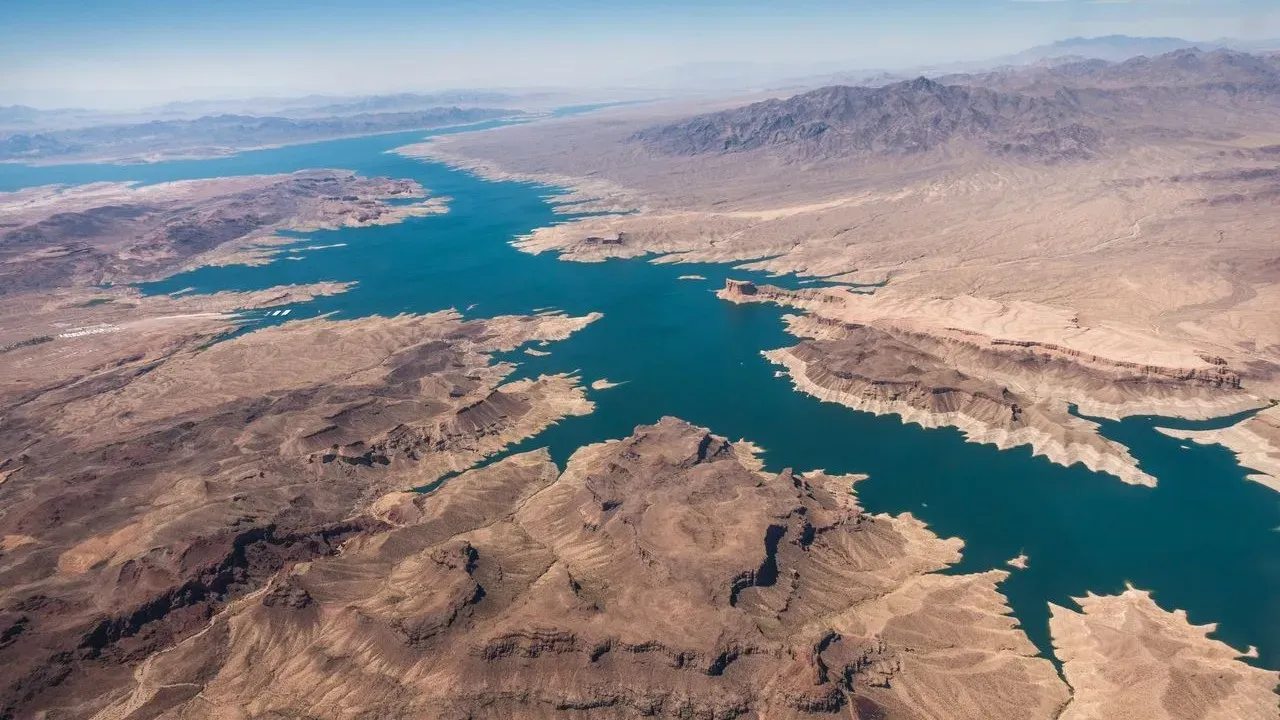

Hydropower output across the Southwest has reached a record low as Lake Powell and Lake Mead sink to levels that threaten electricity generation. ([1])The reservoirs are not yet at the point where their dams stop producing power, but federal officials and independent researchers now describe that threshold as a realistic prospect within a year or two, depending on snowfall. The question facing the Colorado River system has shifted from how low the lakes can go to how long the dams can keep running.
Two reservoirs, one record-setting summer
The combined storage of the two largest reservoirs in the country fell to its lowest point since 1957 during July, according to federal data. ([2])Lake Powell reached its own all-time low in mid-August, and Lake Mead fell to a historic low in early August. Lake Powell then dropped further in September, bottoming out at 3,516.62 feet on September 15, according to readings compiled by monitoring sites.
Weather patterns explain much of the decline. A winter with very little mountain snow meant the spring runoff that normally refills the reservoirs never arrived in full. ([2])Years of heavy use have compounded the problem, with federal officials noting that water use has exceeded total inflow to the system in most years since 2000.
Why hydropower is the pressure point
Each dam has a minimum power pool, the lowest water level at which its turbines can still generate electricity. For Glen Canyon Dam at Lake Powell, that line sits at 3,490 feet. At Hoover Dam on Lake Mead, it is 950 feet. Once a reservoir drops below its line, water can still pass through the dam, but it bypasses the turbines, so no electricity is produced. ([3])
The output losses are already measurable. Hydropower generation in the region fell 19 percent between April and August 2026 compared with the same stretch a year earlier, based on data from the U.S. Energy Information Administration. ([4])The agency’s November outlook projects regional output for 2026 at 6.13 billion kilowatt-hours, about 9 percent below last year and roughly 24 percent under the 10-year average. ([4])
What matters now
| Reservoir | Minimum power pool | Margin reported in early October |
|---|---|---|
| Lake Powell | 3,490 feet | About 28.6 feet |
| Lake Mead | 950 feet | About 87.9 feet |
Margins are based on a daily reservoir snapshot from October 2, 2026. ([5])
How the federal response is shaping the river
The Bureau of Reclamation began emergency measures in April to keep Lake Powell above the level needed for hydropower. ([6])Officials cut the volume of water flowing from Lake Powell into Lake Mead and called for extra releases from Flaming Gorge, an upstream reservoir in the Upper Colorado River Basin, to hold Lake Powell at or above 3,510 feet. ([4])
That tradeoff carries its own cost. Holding back water at Lake Powell can reduce supply at Lake Mead, which could make it harder to sustain generation at Hoover Dam. ([4])Hoover Dam’s capacity falls sharply when Lake Mead drops below about 1,035 feet, a level the lake has approached in recent months. ([2])
What comes next, and what remains uncertain
Projections for Lake Powell depend heavily on how much snow falls next winter. A July report from the Bureau of Reclamation warned that the reservoir could reach minimum power pool by spring 2027 even with emergency steps in place. ([7])A later October set of studies showed a wider range, with the most likely case keeping Lake Powell above the line through its next 12 months, while a drier scenario dips toward it by early 2028. ([8])
Crossing minimum power pool would not automatically cut water to downstream users, since the threshold is an engineering limit rather than a legal one. ([9])The larger loss would be a flexible source of electricity for millions of customers and a heavier reliance on bypass equipment. The coming winter, and the federal decisions on the river’s long-term management, will determine how quickly that line comes into view.
AI Disclaimer: This article was created with the assistance of AI tools and reviewed by a human editor.