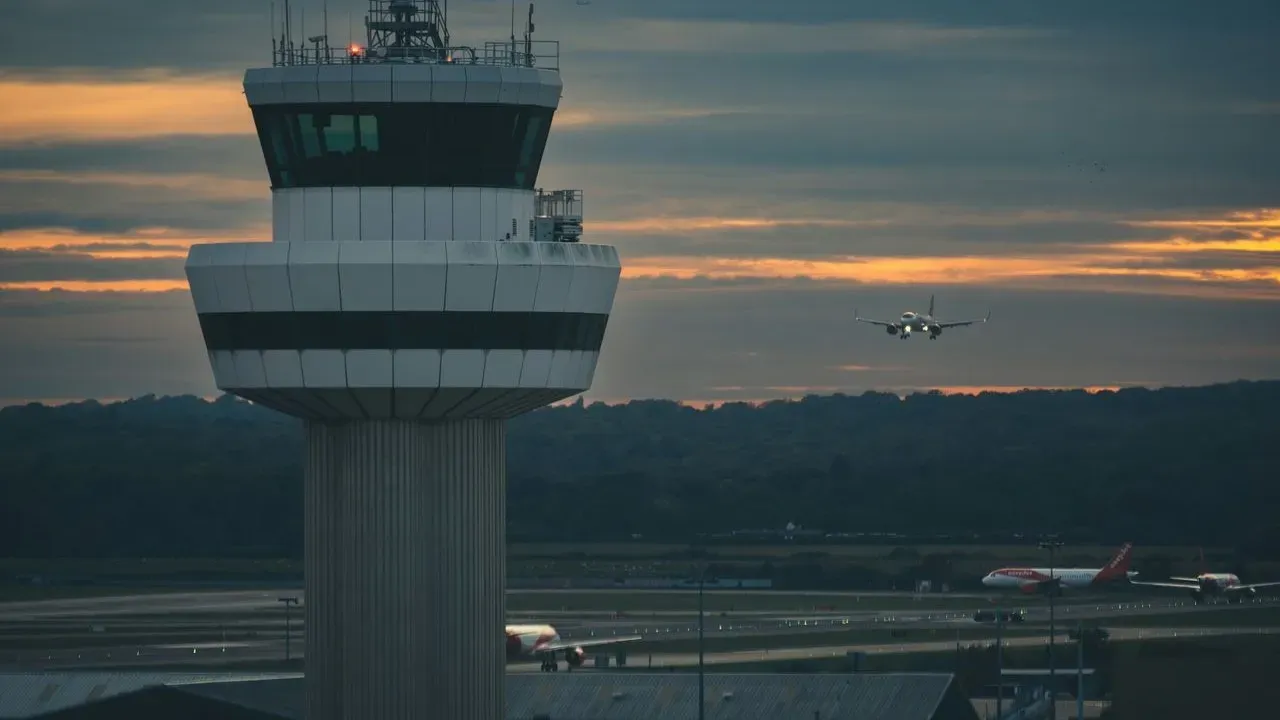

On Friday, a problem inside the communications network that links the nation’s regional air traffic control centers led to an hourslong grounding of flights across the country. Aviation experts describe that network as “one of the largest telecommunications systems in the country,” and say its failures can spread far beyond the place where they begin ([1]). The order was lifted late Friday, but airlines faced days of schedule recovery after many had diverted flights.
Three layers guide every flight
Air travel depends on a chain of controllers, and each link has a defined job. Airport towers handle takeoffs at the more than 500 airports that have them. Terminal radar approach control facilities then guide aircraft as they move away from the airport, and regional centers take over at higher altitudes. Descents follow the same sequence in reverse.
The regional centers are the least visible of the three. The country operates 22 of them, and controllers at each sit before radar displays covering only their own airspace. Stephen Creamer, president of the Air Traffic Control Association, described how a flight moves between them during a handoff. The aircraft must appear on the next controller’s screen before the pilot begins talking to that person, so the transition is never a simple switch.
What officials say went wrong
Transportation Secretary Sean Duffy said during a Saturday briefing that the trouble began while a contractor was replacing sections of old copper wire with fiber. He said the work somehow led to an overload of the system. Officials were still examining whether contractor error or a faulty router was to blame, and no final determination has been announced.
Duffy offered a specific picture of the strain. “Specifically, we had over 1,000 connection attempts every 4 to 5 seconds,” he said, adding that the surge disrupted communication with aircraft and interfered with radar feeds. Federal Aviation Administration Administrator Bryan Bedford said intermittent frequency instability reached as many as 17 of the 22 regional centers. He stressed that the failure was different from a local outage. In his words, “It propagated around the country.”
Officials said planes already in the air were able to land safely using established procedures for such situations. The ground stop itself was ordered as a precaution, with safety cited as the priority.
Why a local failure reached distant flights
The Friday disruption differed sharply from an earlier incident at Newark Liberty International Airport. The contrast helps explain why the latest event drew such wide attention.
| Factor | Newark, September | Nationwide, Friday |
|---|---|---|
| Scope | One airport lost radar communications | Intermittent problems at as many as 17 regional centers |
| Trigger | A backup fiber line was cut by railroad construction workers | A system overload during a network upgrade, cause still under review |
| Result | Hundreds of flights canceled at the airport | A ground stop lasting more than four hours |
Andrew Charlton, an aviation consultant, pointed to the knock-on effect that makes these problems so far-reaching. An aircraft rarely flies a single leg and stops. It typically moves through several airspaces on a routing that carries it across the map, so a delay in one region can ripple into others. Long flights over the Atlantic or Pacific are especially exposed, since they pass through many control areas in sequence.
Michael McCormick, a former FAA airspace manager, described the pattern as a rolling outage. Such failures can strike one center, ease, then reappear at another, which makes them hard to predict. That unpredictability is a major reason the FAA halted flights rather than attempting to manage them piece by piece.
Backup systems and the road ahead
Pilots are not left without options when radio coverage falters. John Hansman, an aeronautics professor at MIT, said pilots can speak directly to one another over radio and can rely on onboard equipment that shows nearby aircraft. Many planes also carry satellite phone systems. If a control tower loses its radio, it can signal pilots with high intensity light beams, including whether it is safe to descend. Hansman summarized the layered approach this way: “We have a number of backup systems that allow the airplanes to fly safely” even when radio contact is limited.
The longer-term fix is a costly modernization effort. Congress approved $12.5 billion for the work last year, and miles of copper have already given way to fiber optic lines, while older radio systems are being replaced at airports. Yet the upgrade remains incomplete, and Duffy has used recent briefings to press lawmakers for more money. The FAA is also moving toward controller pilot data link, a text-based messaging system that would let controllers and pilots exchange routine instructions without relying solely on voice radio.
Friday’s grounding showed how much depends on a network most travelers never think about. Whether the incident prompts faster changes or simply a sharper focus on the upgrade will likely become clearer as investigators finish their review.
AI Disclaimer: This article was created with the assistance of AI tools and reviewed by a human editor.