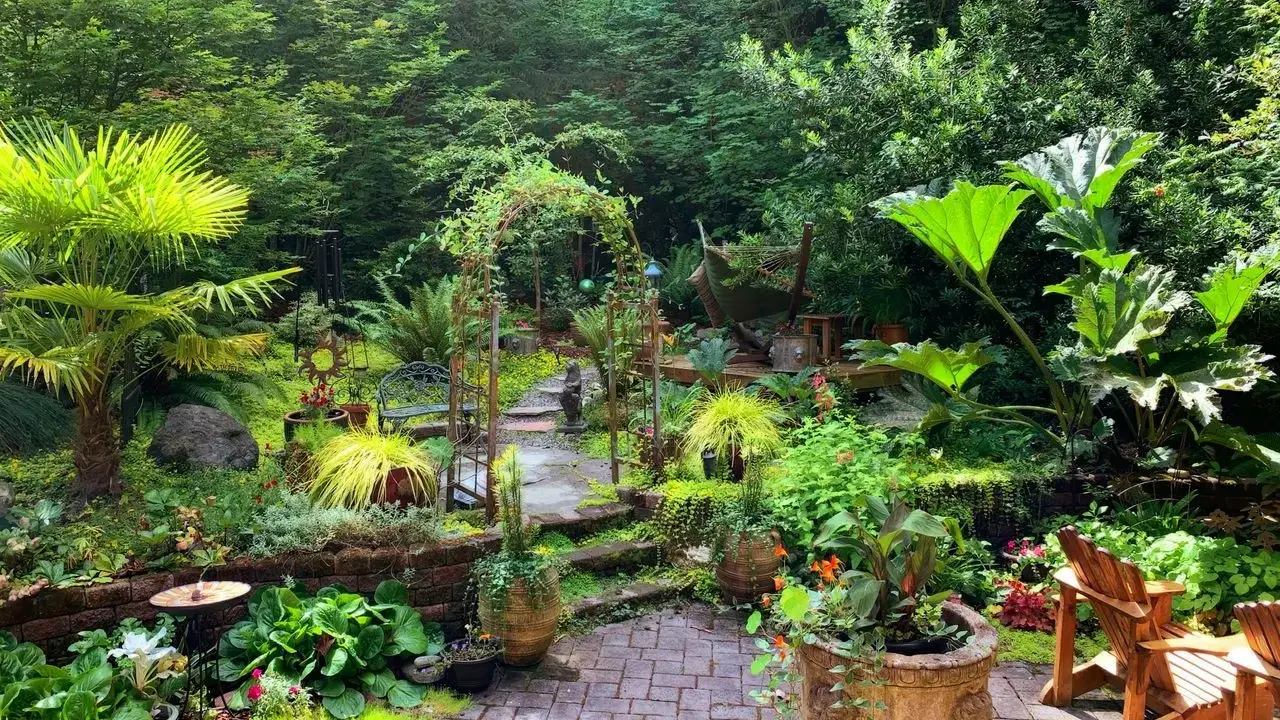

Fine Gardening has profiled a Pacific Northwest garden where careful design addressed the site’s shortcomings and produced a space that feels immersive and welcoming ([1]). The region gives designers a demanding brief. Rain, shade, and long stretches of gray weather shape what thrives and where water goes, so a garden that works here usually begins with a clear reading of the site rather than a shopping list of plants.
Water Comes First
Designers working in wet climates tend to treat drainage as a starting point rather than a repair job. In wet climates, drainage should be part of the design, not an afterthought. Planning that early keeps beds healthy and reduces the amount of water a garden needs in dry spells.
The stakes become clear on steep ground. In Ridgefield, Washington, a sloped backyard once sent every storm down the grade in ruts and left little room for anything but weeds. A recent project by FloraStone Studio reshaped that slope into three levels joined by steps and block retaining walls, with a patio on the top terrace. The project addressed classic Pacific Northwest challenges: steep topography combined with the region’s wet winters. Water ran unchecked down the grade, creating erosion and limiting any practical use of the yard.
Layers That Hold Interest Through the Gray Months
Winter tests any Northwest garden. Designers here often lean on depth to keep a bed from looking empty for half the year. Layering is one of the most effective ways to make a Pacific Northwest garden feel rich and established. In practice, that means combining ground-level planting, mid-height shrubs, and a structural backbone of trees or evergreens so that something always has presence in the composition.
Layers also solve a maintenance problem. A dense planting scheme leaves less bare soil for weeds to colonize, and the plants shade and compete with one another. The approach asks more of the design in its first season, since the spacing and plant choices must be right from the start, but it tends to pay back later with a garden that needs less intervention.
What matters now: Read the site’s water and light before choosing plants. Build drainage into the plan from the outset. Use layers so the garden holds its shape across the seasons.
Designing for Time Spent Outside
A garden that solves problems still has to earn its place as a room. Patios, pathways, seating areas, fire pit spaces, and garden walkways can make a landscape feel more intentional and usable. The difference between a plot that is tidy and one that draws people outdoors often comes down to where a path bends or where a bench sits in the light.
Regional examples show how quickly that shift can happen. In one Northwest Native Landscapes project, a mossy front lawn in Northeast Portland was replaced with a layered, pollinator-friendly garden of Pacific Northwest natives. The lesson carries beyond that yard. Replacing a problem area with purpose often changes how a household uses the entire property, not just the spot that was fixed.
The Fine Gardening profile centers on that same idea, that a garden can be practical and emotionally satisfying at once. For homeowners in the region, the takeaway is less about a single plant or feature and more about sequence. Start with the water, the slope, and the light. Then shape the layers and paths so that the finished space gives people a reason to stay.
AI Disclaimer: This article was created with the assistance of AI tools and reviewed by a human editor.