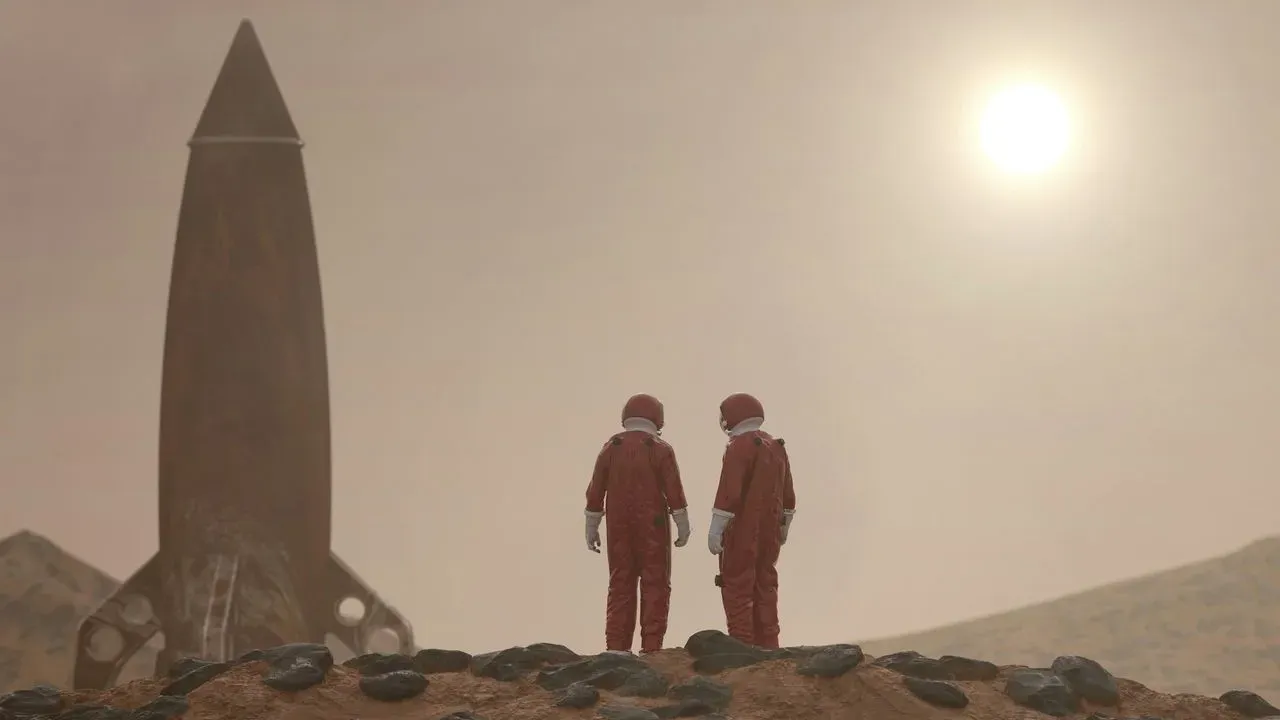

On a Saturday afternoon at the end of October, four people stepped out of a 3D-printed habitat in Houston and back into ordinary daylight. The habitat sits inside a hangar at the Johnson Space Center, and the crew had spent the previous year living as if they were on Mars. Mission commander Ross Elder has since ([1])described how much he underestimated the everyday things he would miss, a reflection that says as much about life on Earth as it does about the mission itself.
A year inside a simulated Mars outpost
The crew entered the habitat, called Mars Dune Alpha, on October 19, 2025. It is a 1,700-square-foot structure, and the team lived and worked inside it for 378 days before leaving on October 31, 2026 ([2]). The four participants were:
- Ross Elder, commander
- Ellen Ellis, medical officer
- James Spicer, flight engineer
- Matthew Montgomery, science officer
None of them are professional astronauts. They were volunteers selected for NASA’s Crew Health and Performance Exploration Analog program, known as CHAPEA. Elder is a U.S. Air Force experimental test pilot, and he drew on that flying background while leading the team. During the stay, the crew had no windows and no real-time calls with family and friends, a set of conditions meant to mirror the isolation of a long planetary expedition ([3]).
This was the second CHAPEA mission at the center. The first crew completed a comparable 378-day stay between 2023 and 2024, which gave researchers a second dataset to compare against ([4]).
The small things that came back first
Elder’s first reflections after leaving the habitat were not about the research. He described the simple pleasure of getting behind the wheel again. “To be honest, it’s just been interesting to get back in a vehicle and drive again,” he said. “That’s an experience we haven’t had for a year.” For someone who spent a year without a car, a commute or a trip to the store, that answer carries more weight than a technical summary would.
He also made a point that many people will recognize. Chores do not disappear when you leave a confined space. Elder listed maintenance, trash, and cleaning showers and toilets as the tasks that remained waiting once the crew stepped out. “All those things are still there,” he said. “Those don’t go away.” His comment suggests that the surprise was not the absence of hardship but the way ordinary routines return in full, even after a long break from them.
The crew’s exit was also a moment of reunion. Families welcomed the team back to Earth, and the crew’s first public steps outside the habitat came after more than a year indoors ([5]).
What the experiment is meant to teach
The study looks well beyond personal comfort. NASA is working toward a return to the moon in about two years, and Elder said his crew’s work on the ground may help the astronauts who go there. He was careful about the limits of that progress, however. “There are difficulties with technology, the distances, the time delays, and other challenges that we sat out on CHAPEA to work through, but they’re not all solved,” he said.
Communication delay was among the most important variables. Vanessa Wyche, director of the Johnson Space Center, said the volunteers managed limited supplies, kept their surroundings in order, and adjusted to delayed contact with mission control. Those skills will matter when astronauts cannot depend on immediate guidance from Earth ([6]).
Key points from the mission
- Duration: 378 days, from October 19, 2025, to October 31, 2026
- Setting: a 3D-printed habitat inside a hangar at Johnson Space Center
- Focus: isolation, limited resources, and communication delays
- Participants: four volunteers, not professional astronauts
A commander’s view of the path to Mars
Elder’s experience has not made him less eager to fly. He said the year did not discourage him from applying to become an astronaut. “Sign me up,” he said. “I would love to have that opportunity.” He added that he expects his name to appear on a future astronaut candidate list.
His remarks after leaving the habitat were also measured. He acknowledged that “for Mars, the risks are great,” yet he framed the goal of sending people to Mars as achievable through leadership, teamwork, and careful preparation. He described the crew’s work as laying groundwork for “long-duration deep space exploration” ([5]).
The lesson from the crew’s year is not that Mars is close. It is that the human side of the journey, from the long wait for a message to the return of routine chores, is part of the engineering problem. Elder’s most telling remarks may be the quiet ones about driving a car and cleaning a shower, because they show how much daily life depends on things people rarely notice until they are gone.
AI Disclaimer: This article was created with the assistance of AI tools and reviewed by a human editor.