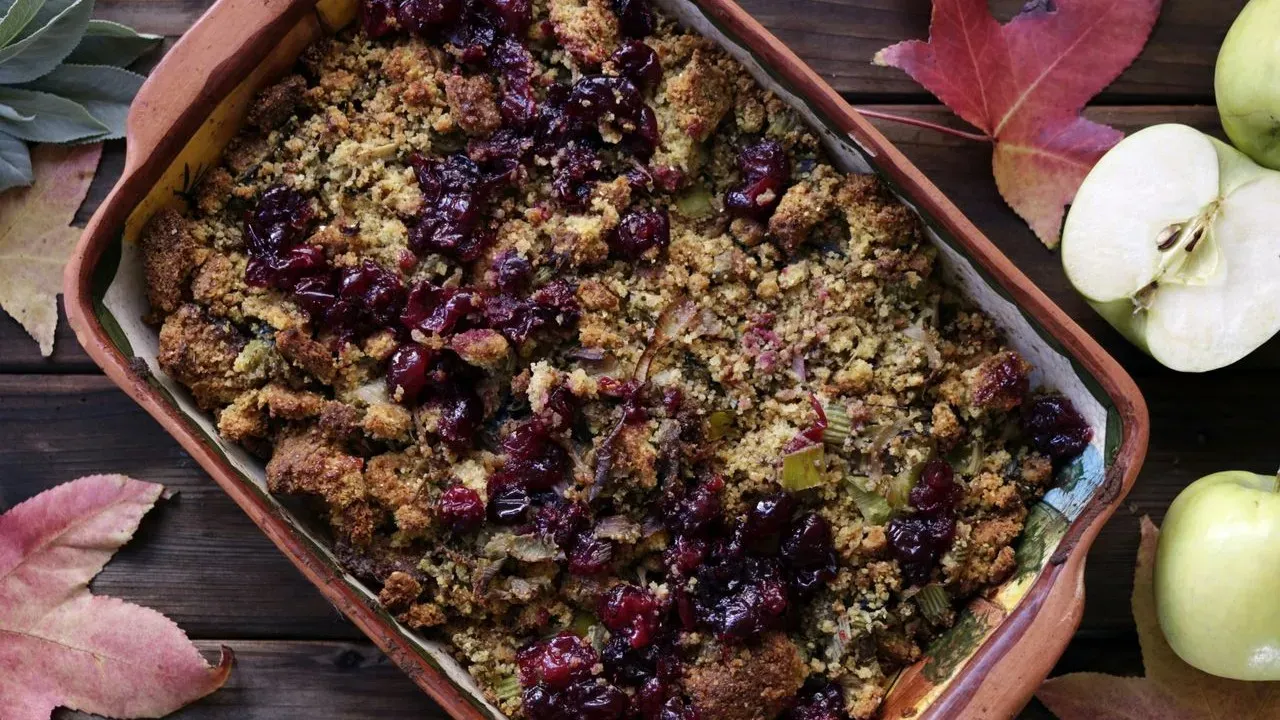

The two dishes share nearly the same recipe, yet they carry different names across the country. According to ([1])and University of Arkansas Extension, stuffing and dressing are made from the same basic ingredients, and what people call them depends largely on where they live. With Thanksgiving about two weeks away, the naming split is a good place to start, though the food-safety rules that apply to either version matter more than the label.
One dish, two names
Both versions are usually seasoned bread mixtures flavored with onion, celery, and herbs such as sage and thyme. The word a cook chooses tends to follow family tradition and regional habit. University of Arkansas Extension notes that people in the South typically say dressing, while many people in the northern states say stuffing.
Cooking method adds a second layer of confusion. Many cooks use stuffing for the mixture baked inside the bird and dressing for the mixture baked in its own dish. That is a kitchen convention, not an official rule, and plenty of households use both words interchangeably for the same casserole.
What changes from one region to the next
The base ingredient often reveals where a recipe comes from. Arkansas Extension identifies cornbread as the most common Southern ingredient in dressing. Coastal communities may add oysters, Louisiana cooks often use andouille sausage, and California versions can feature sourdough and mushrooms. The USDA adds that stuffing can include grains, pasta, fruit, vegetables, sausage, giblets, and nuts, which makes the category broader than many people assume.
| Term | Where it is more common | Typical setup |
|---|---|---|
| Stuffing | Northern states | Often baked inside the turkey |
| Dressing | The South | Often baked in a separate dish, frequently with cornbread |
The table reflects common usage rather than strict definitions. Some Southern cooks call a casserole-baked version dressing, and the terms overlap far more than the labels suggest.
The detail that matters more than the name
A fully cooked turkey does not guarantee safe stuffing. The USDA says the turkey and the stuffing must each reach a safe minimum internal temperature of 165 degrees F, which is why the agency recommends baking stuffing separately for even doneness and the lowest risk.
Cooks who still prefer the bird-cooked version can follow a few steps to keep it safe:
- Spoon the stuffing in loosely, about 3/4 cup per pound of turkey.
- Keep the mixture moist, since heat destroys bacteria more rapidly in a moist environment, according to Arkansas Extension.
- Put the bird into an oven set no lower than 325 degrees F right after preparing it.
- Check the center of the stuffing, the innermost thigh and wing, and the thickest part of the breast, making sure each reads 165 degrees F.
- Let the stuffed turkey stand for 20 minutes before removing the stuffing.
Oyster stuffing needs one more step. The USDA recommends cooking the oysters first.
Making it ahead and handling leftovers
Make-ahead cooking is possible, but it has limits. The USDA advises against refrigerating fully assembled, uncooked stuffing. Cooks have three safer routes: prepare the wet and dry ingredients separately and keep them chilled until baking, freeze the combined uncooked mixture right away in a shallow container without thawing it first, or cook the stuffing in advance, divide it into shallow containers, refrigerate it promptly, and reheat it to 165 degrees F.
Leftovers follow a similar timeline. Cooked stuffing should go into the refrigerator within 2 hours of cooking or of coming off a warming appliance, or within 1 hour if the room is above 90 degrees F. Large batches should be divided and cooled to 40 degrees F or below. The USDA says refrigerated stuffing should be eaten within 3 to 4 days and reheated to 165 degrees F.
Call it what your family calls it
The Thanksgiving debate may never be settled across the country, and it does not need to be. The name on the serving spoon reflects family history, regional habit, and the ingredients that happened to be in the pantry. What carries across every kitchen is the same temperature target. Whether the dish sits in the bird or in a buttered casserole, a center reading of 165 degrees F is what makes it ready to serve.
AI Disclaimer: This article was created with the assistance of AI tools and reviewed by a human editor.