
Few kitchen habits inspire as much quiet judgment as how you handle the dishes. Some people have the last bite barely swallowed before they’re running the tap. Others stack everything neatly in the sink, pour in a splash of dish soap, and call it tomorrow’s problem. Neither camp is wrong. They’re just different. What’s more interesting is what that difference actually reveals.
Psychology has spent a surprising amount of time looking at exactly this kind of small, repeated behavior, and what comes back is a nuanced picture. Where you land on the dish spectrum says something real about how you manage stress, structure your day, and relate to your own mental energy. Here’s what the research tells us.
Washing Right Away Signals Strong Self-Regulation
Washing dishes immediately demonstrates self-regulation, the ability to manage your behavior according to your values rather than your feelings. That distinction matters. Most people want a clean kitchen; immediate washers actually follow through before comfort wins the argument.
Immediate dish washing requires overriding the natural human impulse to relax after eating. Conscientiousness ranks as one of the Big Five personality traits, and research consistently shows that immediate dish washers score significantly higher on this dimension than the general population. This isn’t a small personality footnote. Conscientiousness is one of the most studied and consequential traits in all of personality science.
Letting Them Soak Can Mean You’re Running on Empty
There’s a body of psychological research, going back to the late nineties, on something called ego depletion or decision fatigue. The original work was led by social psychologist Roy Baumeister, and the basic finding was that self-control and decision-making seem to draw from a limited pool of mental energy.
Some aspects of Baumeister’s original ego-depletion model have been challenged in replication studies. The core observation that people make worse decisions and resist tasks more when their cognitive resources are depleted has held up in multiple frameworks. In other words, leaving dishes in the sink at the end of a brutal day may say less about character and far more about capacity.
Your Sink Reflects Your Big Five Personality Profile
The Big Five personality model is a framework psychologists use to describe five broad dimensions of personality: openness, extraversion, agreeableness, neuroticism, and conscientiousness. Conscientious people tend to be organized, reliable, disciplined, and thoughtful about following through on commitments.
A study published in the Annals of Behavioral Medicine found that conscientiousness is a consistent predictor of longevity, even after controlling for factors like education, substance use, and existing health conditions. So in a roundabout way, the dish habit is entangled with traits that show up well beyond the kitchen.
The Mess in the Sink Is Raising Your Cortisol

A study published in the journal Personality and Social Psychology Bulletin found that women who described their homes as cluttered or unfinished had higher cortisol levels throughout the day than women who described their homes as restful and restorative. The effect persisted across the full day: the stress response to a cluttered home doesn’t switch off when you leave a particular room.
Research published in Personality and Social Psychology Bulletin and related investigations suggest that cluttered environments correlate with cortisol elevations ranging from roughly one fifth to one quarter higher compared to organized spaces. A stack of dishes isn’t just an eyesore; it’s a background stressor running quietly the whole time it sits there.
Immediate Washers Tend to Be Precrastinators
Immediately washing dishes after cooking often points to strong executive function and impulse control rather than mere tidiness, according to psychologists studying the behavior. The habit overlaps with precrastination, a documented tendency to knock out tasks right away, and has been linked in research to lower stress through reduced visual clutter.
Experts note the same instinct can also signal performance anxiety when it tips into compulsion. There’s a meaningful line between healthy proactivity and an anxious need to clear every surface the moment it’s used. Most people who wash right away sit comfortably on the healthy side of that line, but it’s worth knowing the line exists.
Soakers Are Often More Comfortable with Uncertainty
Journalist Maggie Jackson, in a conversation with Greater Good about the psychology of uncertainty, described how people who tolerate unfinished or unsettled situations tend to be more curious and make better decisions. Researcher Todd Kashdan calls it “stress tolerance,” the ability to sit with discomfort without needing to resolve it immediately.
Research on adaptability suggests that people who are comfortable with a certain level of disorder tend to cope better when life throws a curveball. The person who can leave dishes overnight without losing sleep may be drawing on the same psychological flexibility that helps them handle genuine disruption calmly.
Mindful Dishwashing Is Its Own Stress Reliever
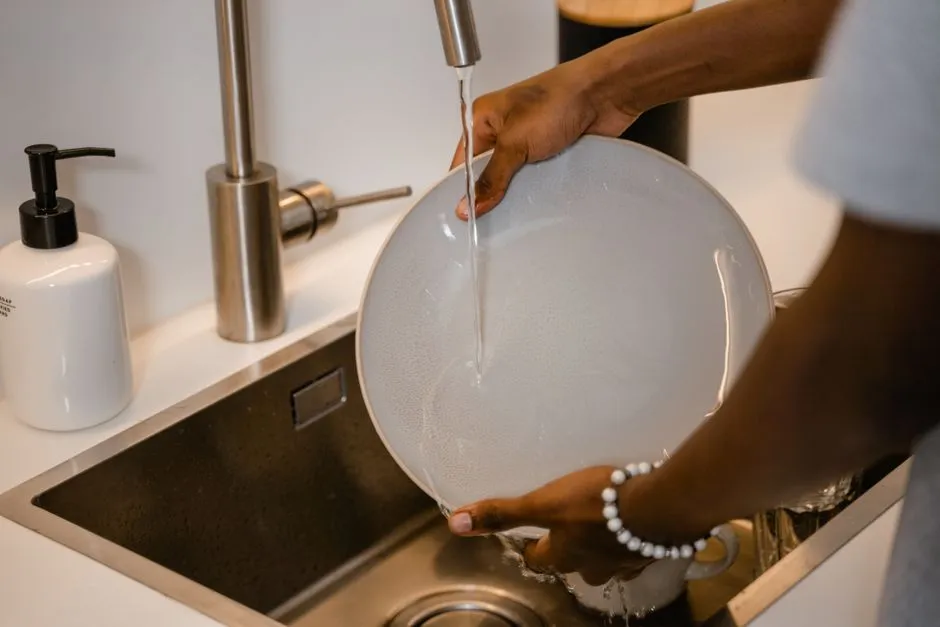
A Florida State study found washing dishes mindfully cut nervousness by roughly more than a quarter, turning a chore into a free stress reliever. The key variable wasn’t the dishwashing itself but the mental state brought to it.
Half of the students read a short mindfulness dishwashing passage and the other half read a short descriptive dishwashing passage. The descriptive passage was straightforward, but the mindful passage focused on being present mentally for the task. Both groups then washed the exact same dishes in the exact same kitchen setup, and only the instructions differed. The lesson here is that how you do the dishes may shape your mood just as much as when you do them.
Clutter Affects Your Food Choices Too

The kitchen affects behavior more than cognition. A cluttered kitchen increases the likelihood of making less healthy food choices. Research from Cornell University found that people in chaotic kitchen environments consumed significantly more calories than those in calm ones, a finding the researchers attributed to the stress response activated by environmental disorder.
This is an underappreciated downstream effect of a pile of dishes. It’s not just about the dishes themselves but about what that visual chaos quietly does to your decision-making in the same space. According to a study in the journal Psychological Science, people who worked in a neat space for ten minutes were twice as likely to choose an apple over a chocolate bar than those who worked in a messy space for the same amount of time.
Depression and Fatigue Can Change the Pattern

Letting go of household tasks is a potential sign of depression. This is worth mentioning plainly, without overstating it. A person who normally keeps a clean kitchen but suddenly finds the dishes piling up without explanation may be experiencing something worth paying attention to.
Work by psychologist Fuschia Sirois, published in 2014 in Self and Identity, tied chronic task postponement to low self-compassion and higher stress, while depression and ADHD frequently involve genuine difficulty initiating tasks. The sink can serve as a small but real signal about what’s happening in a person’s inner life, though it should never be read in isolation.
Neither Habit Makes You a Better or Worse Person
When someone regularly lets dishes pile up, it doesn’t necessarily mean they’re lazy. The psychology here is layered enough that a single kitchen behavior can’t carry that kind of moral weight. Context matters enormously, and so does everything else happening in a person’s day.
The psychology behind this habit is far more layered than “tidy people have it together and messy people don’t.” What is fair to say is that both habits reflect something real: about how we manage energy, respond to visual environments, and define our relationship with small daily tasks. Neither profile is a verdict. They’re just a window.
The Takeaway

The dishes are rarely just about the dishes. They’re a small daily choice that sits at the intersection of personality, stress biology, executive function, and whatever kind of day you’ve had. Research gives us enough to say something meaningful about each habit, without flattening the picture into a simple hierarchy of who’s doing life correctly.
What the science consistently confirms is that the environment you live in affects your mind in measurable ways, and that how you show up for small tasks tends to reflect how you show up elsewhere. That’s worth knowing. What you do with it is, as always, entirely up to you.
AI Disclaimer: This article was created with the assistance of AI tools and reviewed by a human editor.