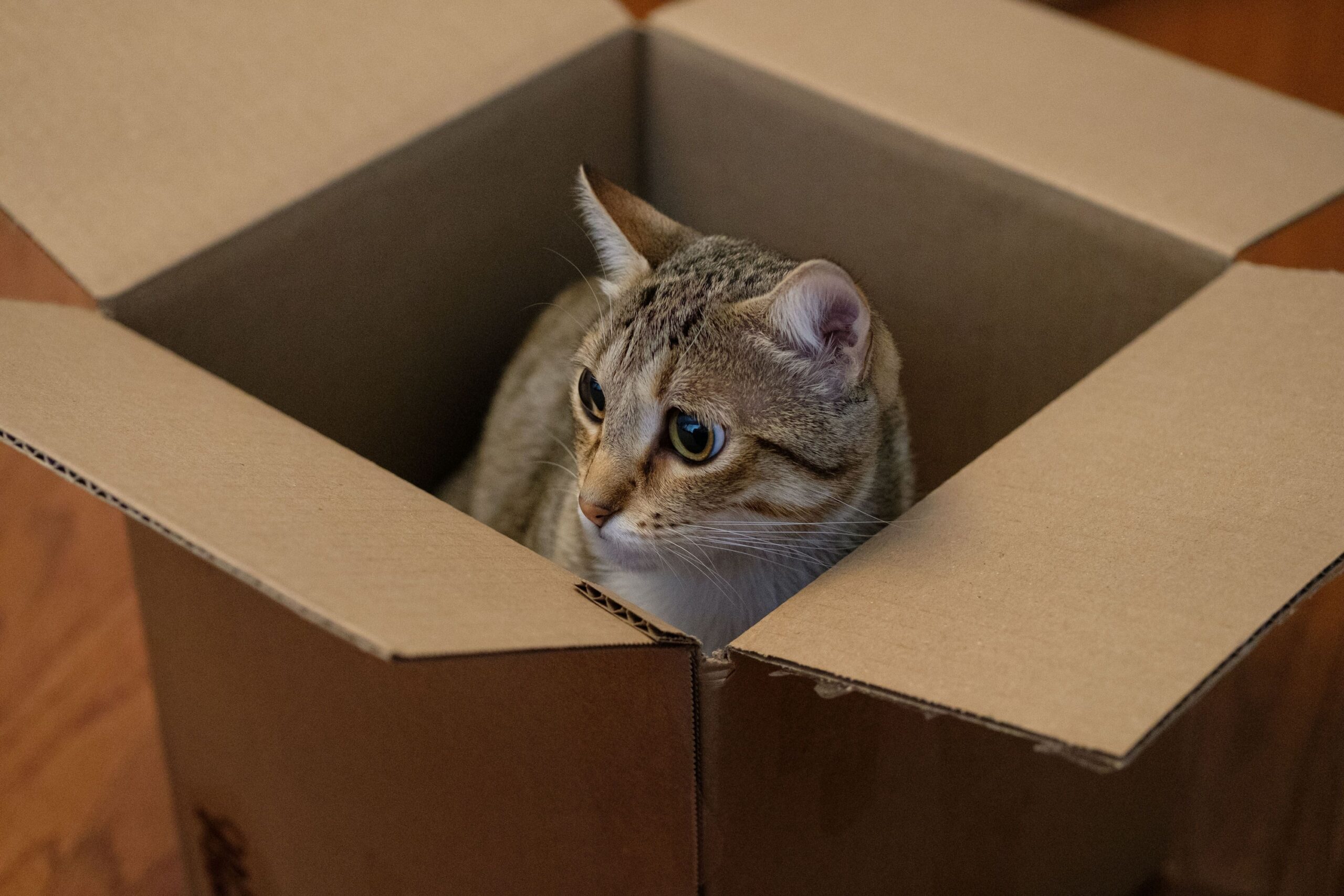

The “If I Fits, I Sits” Instinct Goes Far Deeper Than Boxes
Whether they’re big tigers or domestic felines, cats just seem to love wedging themselves into boxes, crates, or other four-sided objects. Most cat owners know this well. What’s less obvious is why a flat outline on the floor, with no walls and no depth, creates the same pull.
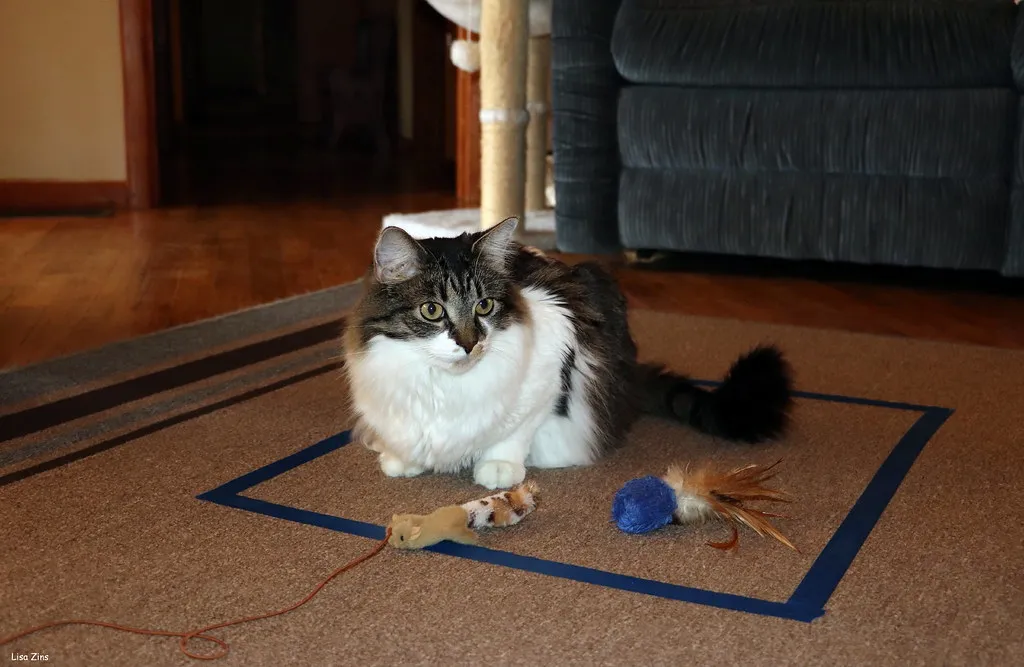
Cats are drawn to squares because their brains perceive even a simple outline on the floor as a defined, enclosed space worth occupying. This behavior is so deeply wired that cats will sit inside a square made of tape, a box with no lid, or even an optical illusion that merely suggests a square’s edges.
The reasons span predatory instinct, stress relief, warmth-seeking, and the way feline vision processes boundaries. It’s not one single drive but a cluster of overlapping instincts that all point toward the same behavior.
The Kanizsa Illusion: Their Brains Fill in the Walls
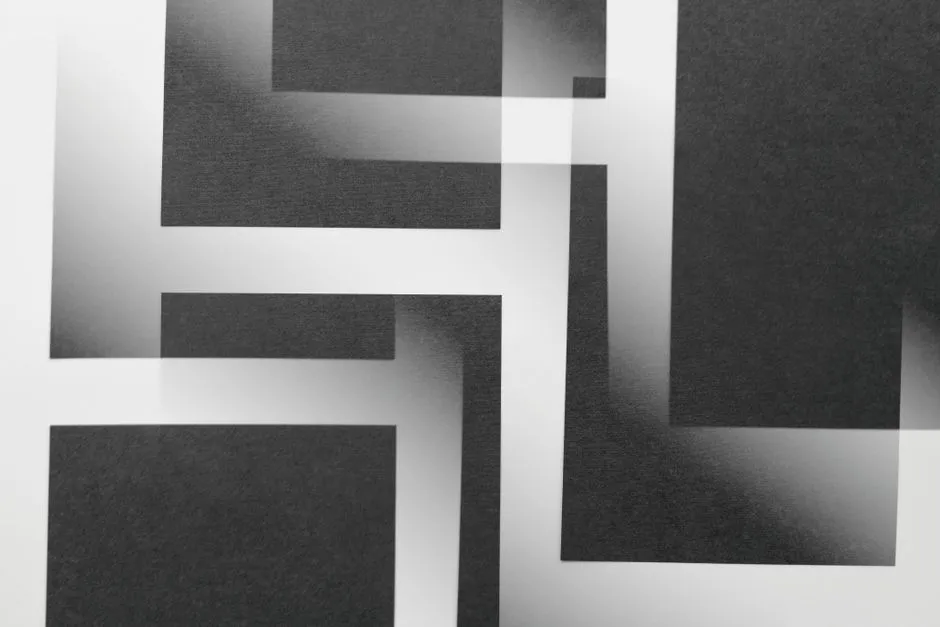
Researchers focused on the so-called Kanizsa illusion. This involved arranging four “Pac-Man” shapes, circles from which a wedge one-quarter the size of each circle is removed, to suggest the contours of a square. No actual lines connect the corners, yet the brain completes the shape.
When human or feline eyes see an outline of a shape, our brains automatically fill in the blanks to create a solid object. We perceive edges that don’t actually exist. When a cat looks at the taped square, their brain processes it as a shallow, three-dimensional box. They step inside because their eyes are telling them it is a secure structure.
As researcher Gabriella Smith explained, cats are susceptible to the Kanizsa illusion in a human-like way, and are most likely attracted to 2-D shapes for their contours, or sides, rather than solely novelty on the floor.
The Citizen Science Study That Confirmed It All
The findings of the study, aptly titled “If I Fits I Sits: A Citizen Science Investigation into Illusory Contour Susceptibility in Domestic Cats,” were published in Applied Animal Behavior Science. It remains one of the most cited pieces of research on this specific behavior.
Every day for six days, each owner put their cat out of the room while they taped a pair of stimuli to the floor. The researchers instructed them each day on which two of three stimuli to use: an actual square, a Kanizsa square in which four Pac-Man type cut-outs are arranged to suggest the lines of a square, and the Kanizsa control in which the Pac-Man type cut-outs face the other way.
Of those 30 cats who completed all the trials, nine cats chose to sit inside a stimulus at least once, and in total between them 16 times. On eight of these occasions, a cat sat inside an actual square. On seven, it sat inside a Kanizsa square. In contrast, the Kanizsa control was chosen only once. This suggests that cats treat the Kanizsa squares just like real ones.
Predator and Prey: The Evolutionary Root of It All
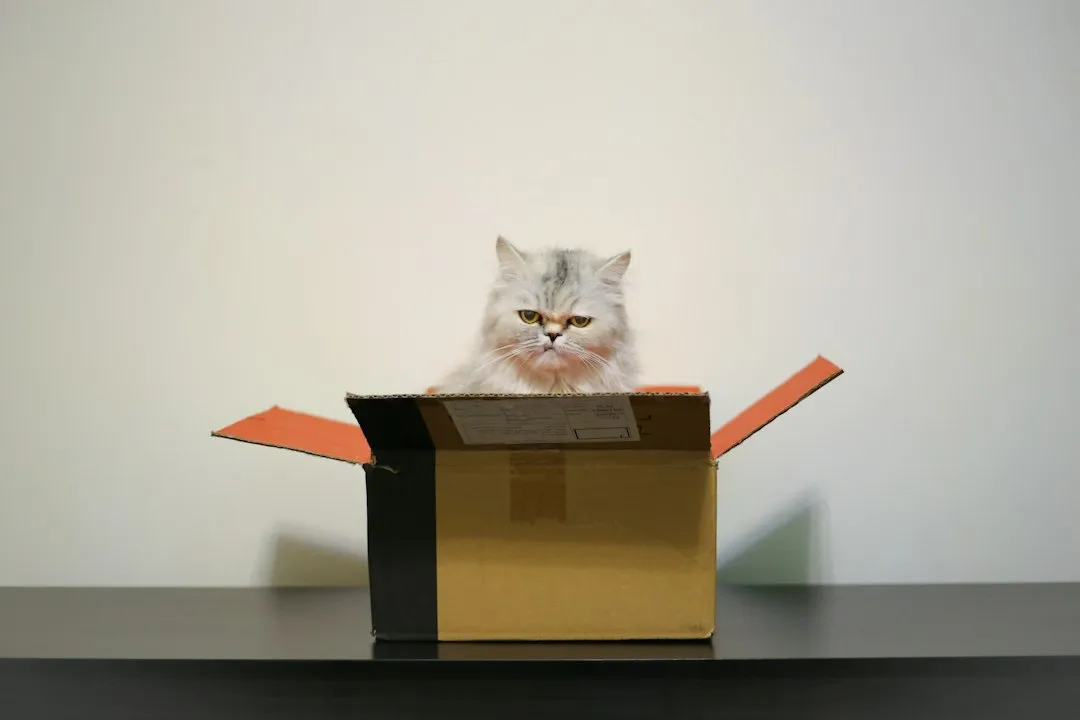
Cats are ambush predators. In the wild, their hunting strategy relies on hiding in dense, enclosed spaces to stalk their prey unseen. Simultaneously, because they are small, they are also prey to larger animals. Sitting in an open, wide room makes a cat feel exposed and vulnerable.
Cats are natural predators, and their instinctual behaviors are rooted in their wild ancestry. In the wild, cats often seek out small, enclosed spaces where they can hide from predators or stalk their prey. Boxes provide a sense of security, allowing cats to feel safe while also offering a vantage point for observation.
Even a 2D square provides a psychological boundary. Just by stepping inside the lines, your cat feels an immediate sense of comfort and lowered stress. Millions of years of evolution don’t care whether the walls are made of cardboard or masking tape.
Stress Relief Is Genuinely Physiological
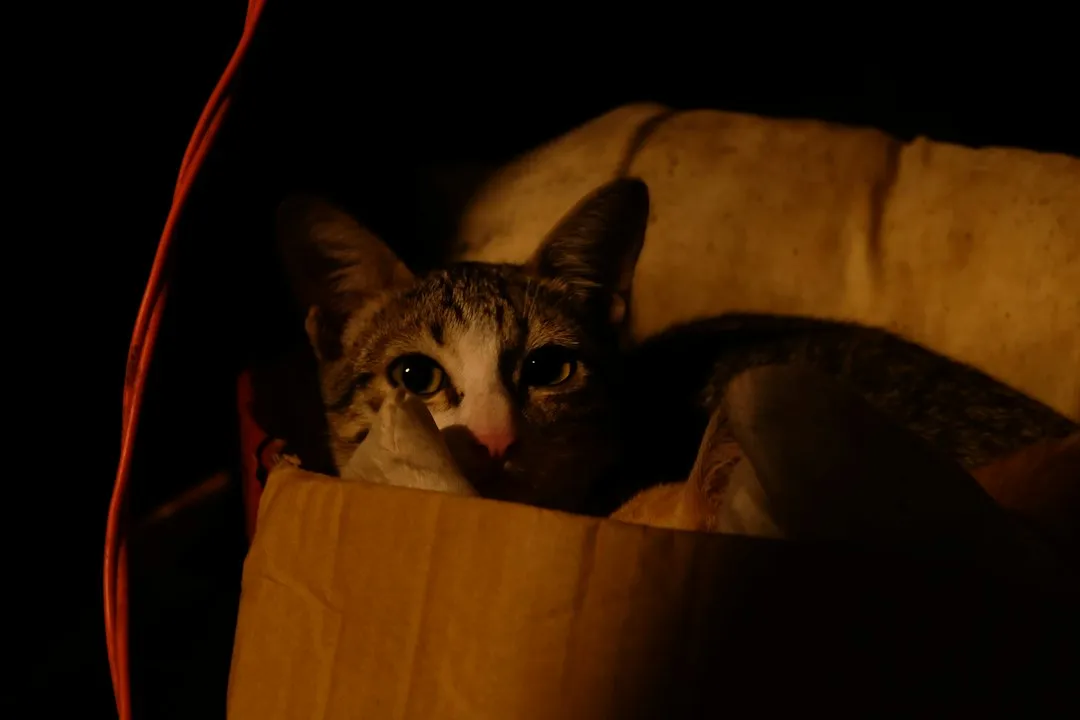
Cats are sensitive animals that can easily become stressed or anxious, especially in new or uncertain environments. Research has shown that confined spaces, such as boxes, can have a calming effect on cats, helping to reduce their stress levels and provide a sense of security. This is particularly evident in shelter environments, where providing cats with boxes and hiding spots has been shown to lower their stress and improve their overall welfare. By seeking out boxes, cats are instinctively gravitating towards a source of comfort and stress relief.
According to Danielle Gunn-Moore, a professor of feline medicine at the University of Edinburgh, a cat’s first experience is a safe, enclosed space. Multiple studies have shown that stress hormones like cortisol are reduced in newly rescued cats when they are given access to a box.
A 2014 Utrecht University study involving 19 cats newly admitted to an animal shelter found that cats given access to a hiding box adjusted more quickly during the early period and showed a faster reduction in behavioral stress scores. That’s a measurable biological response, not just comfort-seeking in the abstract.
Territory and Scent: Claiming the Square as Their Own
When your cat sits on a taped-off square or a square-shaped object, this could simply be her way of marking the territory. Instinctively, they may want to stake out a small portion of space as their own, and sitting on top can help them do that. Sitting on their preferred portion of the surface will also help the cat release their scent, thus claiming the square as their haven.
Cats have scent glands in their paws, cheeks, and chin. Settling into any defined spot, even a temporary one made of tape, deposits their scent and reinforces that this patch of floor belongs to them. It’s a quiet, continuous act of ownership that most people never notice.
Texture and Touch: Curious Paws at Work
Cats navigate the world through their highly sensitive paws and whiskers. A standard hardwood floor or carpet is boring to them. A stripe of tape introduces something new and different, a slight change in texture and temperature that paw pads pick up immediately.
Cats have a keen sense of touch and look for objects with interesting textures. That includes square objects like boxes, a sheet of paper on the floor, a piece of cardboard, and even the shape of a square on a floor with an interesting surface. Not only do they like the feel of textured objects, but since many square objects can be climbed into like a box, they can use them to sharpen their claws or simply get cozy.
The “Perfect Fit” Preference in Feline Behavior
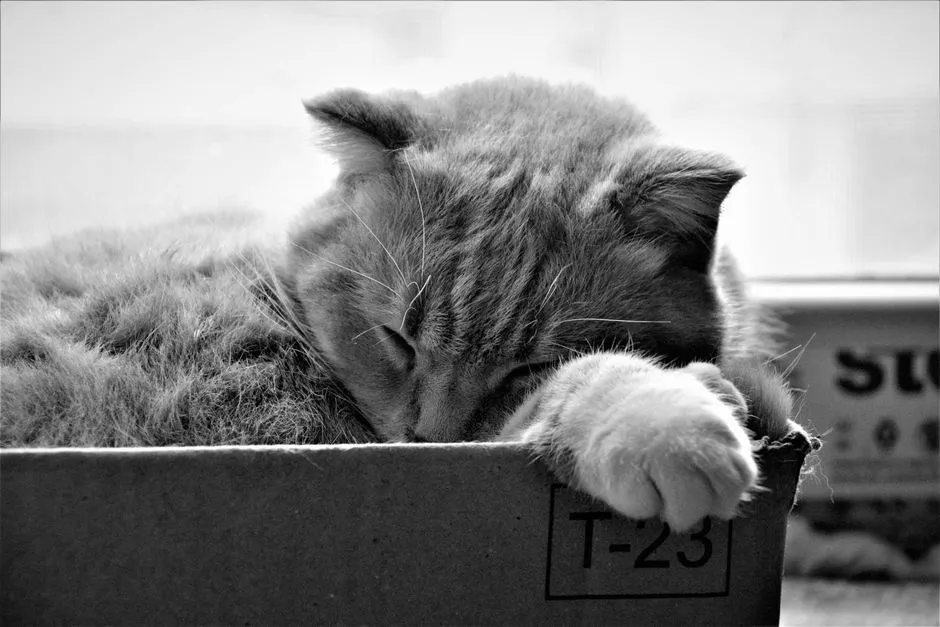
When cats are looking for a comfortable place to take a nap, they have an uncanny ability to find an area that is the perfect fit for their body shape. A square that matches their body width feels tailored rather than random. That’s part of the appeal.
Inside a box, nothing can sneak up from behind or from the sides. Any approaching threat has to come directly into view. This gives cats the comfort and security they need to truly relax. A square on the floor, even without walls, suggests those same protective angles to the feline brain.
The #CatSquare Viral Moment That Sparked Real Science

It’s well known that cats love to sit in enclosed spaces, like boxes. They even like to sit in square shapes made of tape, as documented during a 2017 Twitter craze (#CatSquare). Cat owners across the internet noticed the behavior independently, and the pattern was impossible to ignore.
The scientists reached out to more than 560 cat owners over Twitter to take part in the project. The internet phenomenon, in other words, didn’t just entertain people. It directly shaped a peer-reviewed research project published in a scientific journal, which is a rare case of viral content genuinely advancing animal science.
The study was also the first time cats were tested on visual illusions in an environment familiar to them, allowing them to behave naturally at home. That ecological validity made the results more meaningful than earlier lab-based work.
Big Cats Do It Too: The Instinct Is Universal
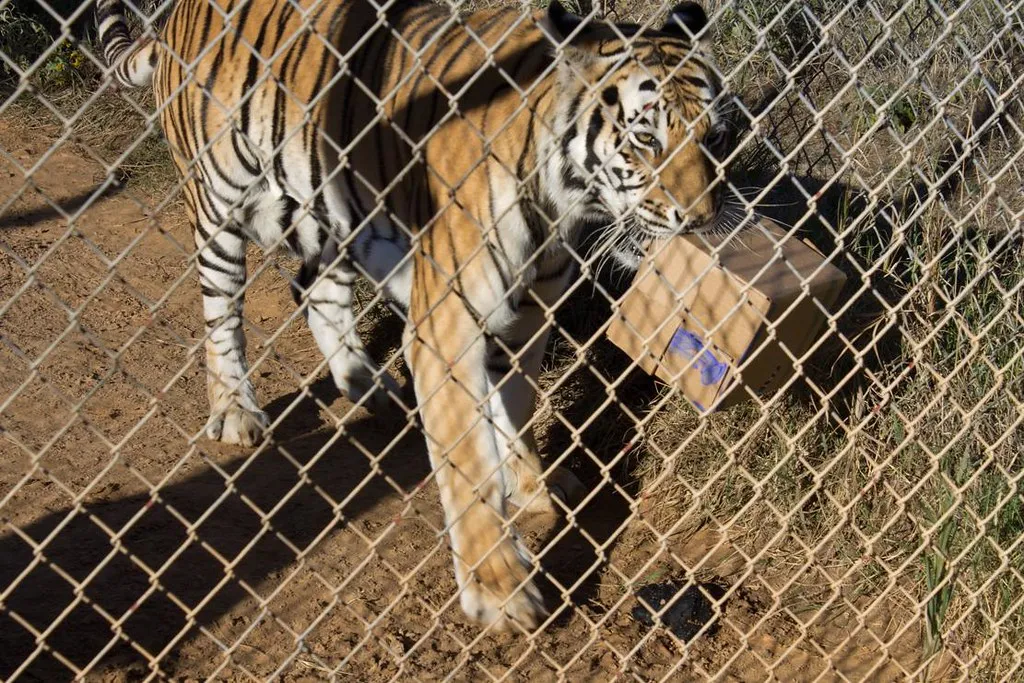
Lions, tigers, and leopards in zoos and wildlife reserves show the same fascination with boxes. When given boxes, these big cats jump in and out, lounge inside, and generally act just like your tabby at home. This cross-species consistency suggests the behavior is deeply embedded across the entire cat family, not a quirk of domestication.
The fact that a tiger and a tabby respond to enclosed boundaries in nearly identical ways points to something fundamental about how the feline nervous system processes space and safety. Domestication has changed a great deal about cats, but this particular wiring appears to have stayed completely intact.
What This Tells Us About Cat Enrichment at Home
Cats aren’t just responding to a physical barrier. Even something as simple as a taped square on the floor can be enriching for a bored indoor cat, precisely because their visual system actively engages with it. That’s worth keeping in mind if you have an indoor cat with limited stimulation.
For a cat, the appeal of these spaces is not just that they are small. They provide cover and, just as importantly, give the cat control over when to stay tucked away and when to come back out. That sense of agency matters more than most people realize.
Studies have found that cats provided with hiding spaces like boxes exhibit lower stress levels, faster adaptation to new environments, and an increased sense of security. A taped square costs nothing, takes thirty seconds to make, and genuinely engages your cat at a neurological level.
The Takeaway
The cat-square phenomenon is one of those cases where internet curiosity and serious science ended up pointing in the same direction. What looks like a random, silly habit is actually a window into feline perception, evolutionary instinct, and how cats manage stress. The boundary matters. The containment matters. Even when none of it is real.
If you want to understand your cat a little better, tape a square on the floor. Watch what happens. The fact that it works every time is not a coincidence; it’s evolution, still running its ancient programs on a creature that now sleeps on your sofa.
AI Disclaimer: This article was created with the assistance of AI tools and reviewed by a human editor.