
Most homeowners assume that if a tree is growing in their yard, it belongs to them. That assumption feels reasonable enough, standing at the window looking out at decades of slow, quiet growth. The reality, though, is more complicated, and thousands of people discover that complexity only after a chainsaw is already running.
Property line errors involving trees can unravel what seemed like a simple decision into a legal and financial ordeal. Whether the issue is a trunk that straddles a boundary, a city-claimed right-of-way that nobody knew existed, or a neighbor who made a unilateral call, the consequences can be significant. What follows covers the ten most important things every homeowner should understand before touching a tree near any property boundary.
How Tree Ownership Actually Works Under the Law
It is accepted law in all states that a tree whose trunk stands wholly on the land of one person belongs to that person. That sounds straightforward. The complication starts the moment a trunk begins to drift, grow, or was planted too close to the edge.
If the trunk stands partly on the land of two or more people, it is called a boundary tree, and in most cases it belongs to all the property owners jointly. That means all the owners are responsible for caring for the tree, and one co-owner may not remove a healthy tree without the other owners’ permission.
It’s worth noting that ownership of boundary trees may vary slightly by state, making it important to learn the local laws to verify ownership of trees on your property line. Skipping that step is where the trouble usually starts.
The Boundary Tree Problem Nobody Warns You About
When the tree trunk is divided by the property lines of two or more people, it is referred to as a “boundary tree,” and all the property owners share ownership and responsibility for it. Tree removal without the consent of all property owners is unlawful.
Both neighbors share ownership and responsibility for a tree whose trunk straddles the line, including decisions about removal. That shared ownership applies even when only one neighbor planted the tree originally, or when only one neighbor has been maintaining it for years.
A jointly owned tree generally cannot be removed without the other owner’s consent; doing so can expose you to a damage claim. That’s a significant exposure for what many people treat as an afternoon yard project.
When the City Claims Your Tree Is Theirs
One of the more surprising situations involves public rights-of-way. Many homeowners have no idea that the strip of land between their fence or lawn and the street is not actually their private property, even though it feels like it is.
A real case from Portland illustrates how this plays out. In April 2024, the city received a complaint from owners of a Southwest Portland home after the city ordered them to remove a tree approximately 30 feet behind their property that had damaged a sidewalk, posing a safety hazard. The cost to remove the tree was estimated at $5,000.
The unpaved section, approximately 30 feet wide and overgrown with vegetation, sits between the property line and a city-maintained street. The property owners cannot directly access the area from their property, nor are they likely able to insure against liability that may be caused by conditions there. They were still told to pay for the removal.
Removing a Shared Tree Without Permission Can Cost You Dearly
You could be liable for monetary damages if you remove a boundary tree without permission. Many homeowners underestimate what “liable for damages” can actually mean in dollar terms once attorneys, appraisers, and replacement costs enter the picture.
If a neighbor removes or destroys your tree without your permission, they are liable for your damages. The exact amount varies by state law and may depend on whether your neighbor acted intentionally or made a mistake.
A high-profile case in north Texas puts a concrete number on the risk. A property owner was fined $54,600 for removing six trees without proper permits. Even though two of the trees were dead and two others were in poor condition, the lack of authorization still led to penalties, reinforcing the importance of obtaining permits and assessments even for damaged or dying trees.
What Municipal Fines Look Like Across the Country
Penalties for unauthorized removal vary widely by location, but they’re generally trending upward. Fort Worth, Texas, increased fines for unauthorized tree removal from $500 to $2,000 per tree in April 2025. That’s per tree, not per incident.
In San Mateo County, California, new penalty fees range from $2,500 to $10,000 per tree for the unauthorized removal of significant and heritage trees. The dollar amounts reflect a broader shift in how municipalities are treating urban canopy.
In Portland, unauthorized removal of a typical 24-inch Heritage Tree could trigger restoration fees of approximately $22,656 plus daily penalties up to $30,000 over 30 days, potentially totaling $50,000 or more in total liability. Those are not numbers that most homeowners budget for.
The Real Cost of Removing a Tree the Right Way
Even when removal is perfectly legal and permitted, it isn’t cheap. On average, tree removal costs between $200 and $2,000, with an average of $750. Larger or more complex jobs go well beyond that range.
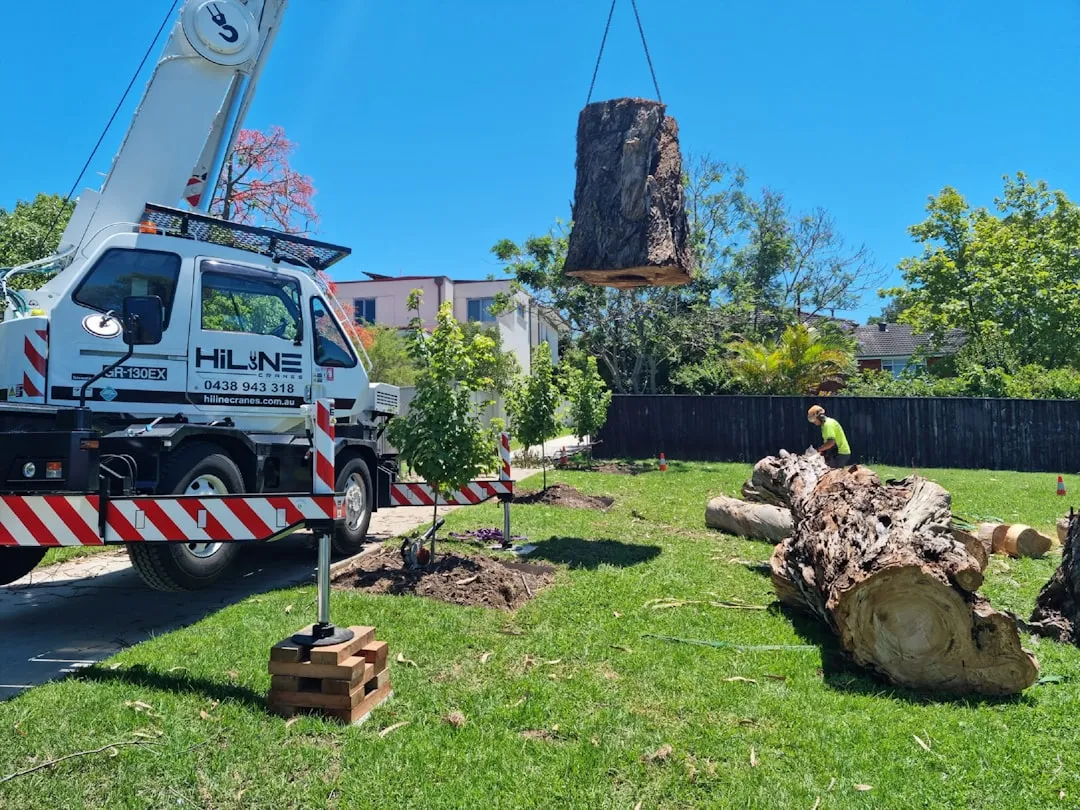
Trees over 80 feet typically require a crane, adding roughly $500 per day, and that extra machinery can push a complex job to $6,000 or $7,000. Factor in stump removal and cleanup, and the final bill climbs further.
The financial gap between doing it legally and doing it without the right approvals can be enormous, and that gap widens considerably once fines and restoration requirements enter the picture. Getting an arborist assessment before any work begins is usually the cheapest insurance a homeowner can buy.
Encroaching Roots and Overhanging Branches: A Different Set of Rules

Tree branches hanging over your property line can cause property damage by dropping debris, clogging gutters, or brushing against your house. That’s a common grievance, and the law does give neighbors some recourse, though it’s more limited than many assume.
If the tree branches are hanging over your yard or the tree trunk is encroaching on your property, then you have a right to trim those branches up to the property line. That right stops exactly at the line, though. Going further, or causing harm to the tree in the process, can create liability.
Encroaching roots can not only kill vegetation but also destroy underground structures such as septic tanks. In those situations, the affected property owner has stronger grounds for legal action, but they still cannot simply take a chainsaw to the problem without proper process.
Why a Survey Is Worth More Than You Think

The foundational mistake in almost every property line tree dispute is assuming the line is where it appears to be. Fences, driveways, and landscaping often don’t align with the actual recorded boundary. Only a licensed survey establishes the true legal line.
Laws vary among states, counties, and cities, so it is important to consult with local authorities before you break out the saw. A survey is the starting point for that consultation because without it, no one is working from accurate information.
Having the actual boundary confirmed before any tree work eliminates a wide range of risks. It tells you definitively whether the tree is yours alone, shared, or technically rooted in a public right-of-way. That single piece of information can change everything about what you’re legally allowed to do next.
How to Handle a Shared Tree Dispute Without Going to Court

Talk to your neighbor early, agree in writing on inspection and cost-sharing for any shared tree, and keep records. That approach resolves the vast majority of boundary tree situations before they become adversarial. A written agreement is far cheaper than a lawsuit.
Mediation through local community boards or neighborhood associations can resolve disputes faster than the court system. Many municipalities offer this as a free or low-cost service, and it tends to preserve the neighborly relationship better than formal litigation does.
Resolving issues with neighbors and trees requires a delicate touch. A lawyer can review the facts and provide information tailored to specific circumstances and local laws. Before taking action into your own hands, reaching out to an experienced real estate attorney in your area is often the most practical first step.
When Even Dead Trees Require a Permit

Many homeowners reasonably assume that a dead or dying tree is theirs to remove without asking anyone. That assumption is partly correct, but only partially. In many jurisdictions, property owners can remove dead or diseased trees without a permit, as this is often considered necessary for the surrounding environment’s safety and well-being.
The critical word there is “many,” not “all.” The north Texas case is a reminder that this exception has limits. Even trees that were dead or in poor condition still triggered penalties when removed without authorization, reinforcing that a permit or at minimum a professional assessment is necessary regardless of the tree’s condition.
Certain large or historic trees may require a permit for removal even if they are on your own property. Age, species, and size can all push a tree into a protected category that local ordinances regulate, independent of whether the tree is healthy. Checking with local planning or urban forestry offices before any removal is not bureaucratic caution. It’s basic financial self-defense.
The Takeaway: Know the Line Before You Touch the Tree
Property line tree disputes sit at a messy intersection of real estate law, municipal code, and neighbor relations. The costs, when things go wrong, are real and can be staggering. A tree may have significant monetary value to the homeowner depending on the location and yard’s landscaping, including decreased property value if the tree is removed or damaged and expenses to treat, remove, or replace it.
The pattern in most disputes is the same: a homeowner acts on an assumption about where their property ends, without verifying it. That assumption costs them trees, money, or both. A survey, a call to local planning, and a conversation with a neighbor before any work begins can prevent nearly all of it.
Trees take decades to grow. The paperwork to protect them takes a few days. That imbalance alone should be enough to make anyone slow down and check first.
AI Disclaimer: This article was created with the assistance of AI tools and reviewed by a human editor.