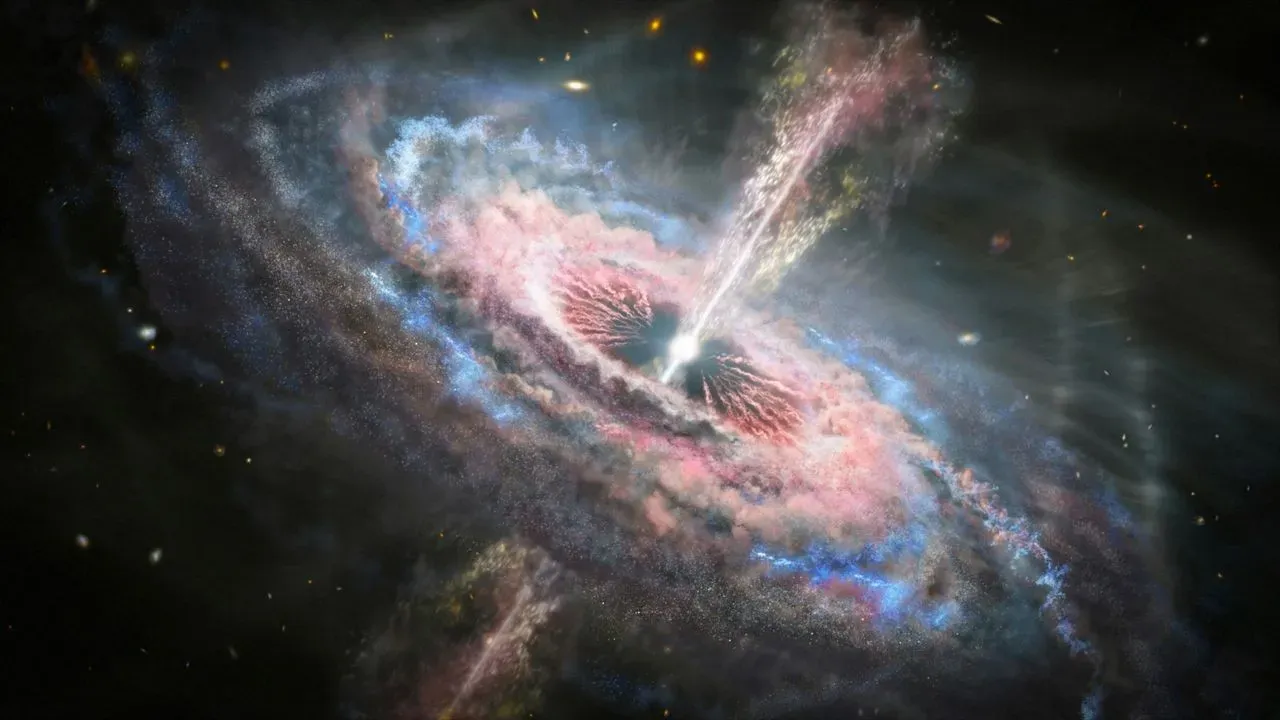

Astronomers have identified a newly discovered space object that defies standard classification. It appears as a star roughly the size of our solar system yet generates energy output on a scale that exceeds typical stellar activity by a factor of 100 billion. The find has prompted researchers to label it a “black hole star,” highlighting its unusual combination of appearance and power source.
The Scale of the Discovery
Observations place the object in a category that bridges familiar stellar phenomena and more extreme cosmic engines. Its apparent size matches the diameter of the solar system, creating an initial impression of an oversized star. Energy production, however, reaches levels far beyond what nuclear fusion in ordinary stars can sustain.
This contrast has drawn attention from teams monitoring distant regions of the universe for unusual signatures. The detection relied on advanced telescopes capable of capturing faint signals across vast distances. Data analysis revealed consistent patterns that ruled out conventional explanations such as supernovae or standard quasars. Instead, the readings pointed toward a central mechanism capable of sustained, extreme output while maintaining a star-like outer profile.
Why Classification Remains Challenging
Standard models of stellar evolution do not account for an object that combines such dimensions with this level of luminosity. Black holes typically reveal themselves through accretion disks or gravitational effects rather than mimicking the surface appearance of a star. The current case suggests an internal structure where a black hole may drive the energy release while an outer envelope produces the visible star-like traits.
Researchers continue to examine whether the object represents a transient phase in galactic evolution or a stable configuration. Additional observations are needed to determine its distance, exact composition, and long-term behavior. Early findings already indicate that similar objects could have played roles in the rapid growth of early galaxies.
Implications for Future Observations
The identification opens new avenues for surveys targeting compact, high-energy sources. Instruments with improved sensitivity may locate more examples and help map how these objects fit into broader cosmic timelines. Understanding their formation could refine models of how matter and energy interact in the densest environments.
Teams are now prioritizing follow-up studies to measure variability and spectral details. Such work may clarify whether the energy output remains steady or fluctuates in ways that reveal the underlying engine. The discovery underscores how ongoing advances in observational astronomy continue to surface phenomena that expand existing frameworks.
AI Disclaimer: This article was created with the assistance of AI tools and reviewed by a human editor.